In the opening of his 1991 book, The Monument: Art, Vulgarity and Responsibility in Iraq, Iraqi scholar and art historian Samir al-Khali described how, on August 8 1989, in the centre of Baghdad, an “important new monument was opened to the Iraqi public”. He continued –
“the invitation card sent to selected guests rightly describes it as ‘one of the largest works of art in the world’ [and that] the ‘Victory Arch’, as it is called, was conceived by the President of Iraq, Saddam Hussain [whose] initial sketch and extract from that speech were reproduced on the invitation card.”
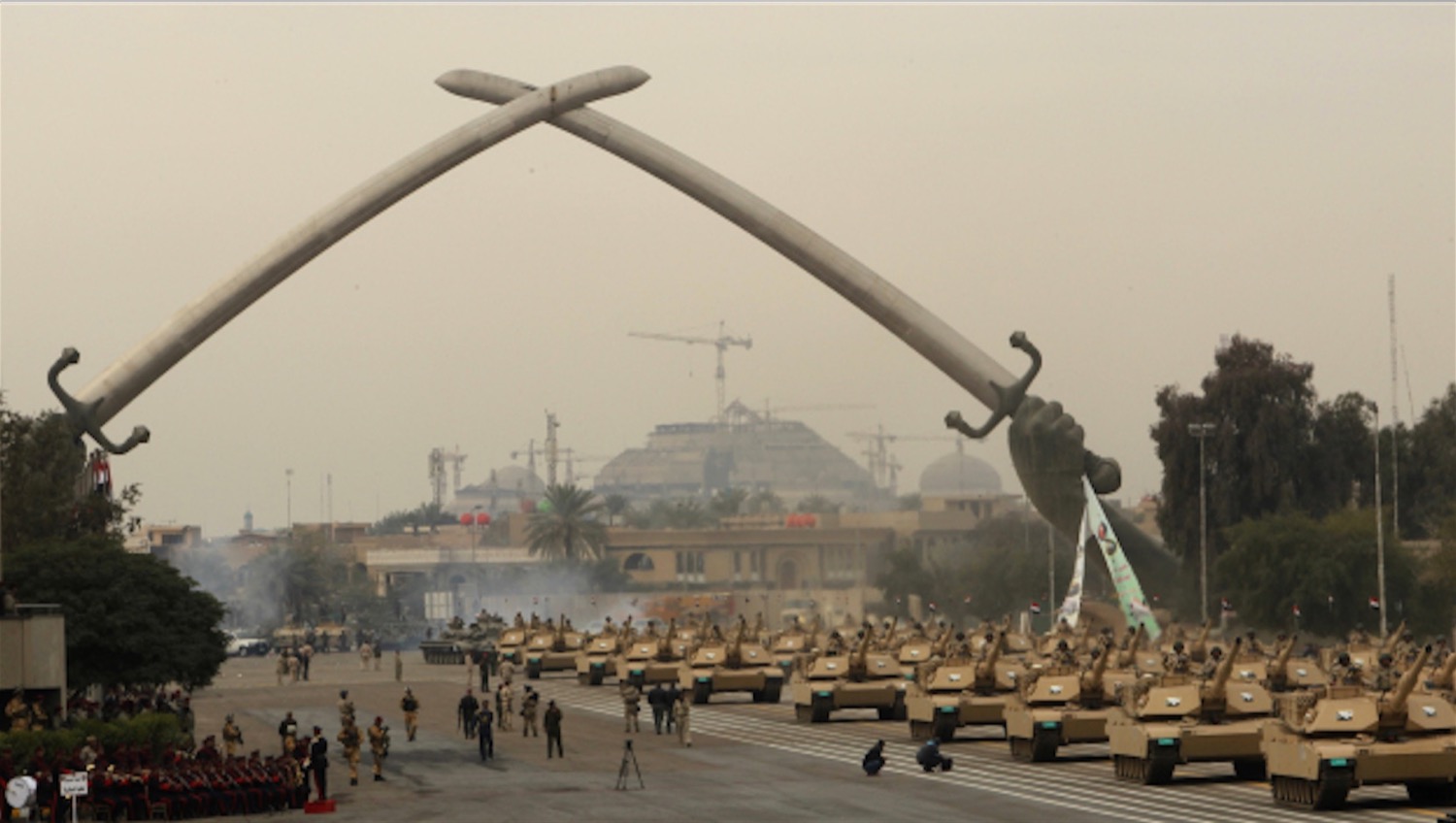
That card depicts the face of the country’s President beneath a rough visualisation of the iconic crossed swords of the Victory Arch, designed and constructed by sculptors Khalid al-Rahal and, after his death, Mohammed Ghani. In Arabic it is known as the ‘Arch of Triumph’, or the Swords of Qadisiyah. Readers in the West might be familiar with the monument from the Gulf War, from a now famous instance of war reportage in which an American M1 Abrams tank is seen to pass beneath the crossed swords of the city. Who knows whether or not that shot was staged, as the toppling of Hussain’s statue, in 2003, was also staged. A more revealing, and perhaps more honest, insight is provided by a short film uploaded to YouTube on October 5 2011. Here, the filmmaker, after driving with a convoy of US Humvees, ascends the structure’s interior in order to climb into the hollow spaces of the statue’s hands. “That’d be a really tight fit”. They may not be aware of it, but the hands had been modelled on Saddam’s own. (Later, in February 2007, an Iraqi governmental body was founded to remove symbols of Saddam from the country. Against protests from preservation groups and civilians alike, work to demolish the Arch began on Tuesday 20, 2007. Some claim that 10 ft “chunks” had been removed from the statue, and others carried away by soldiers and civilians, before the demolition was interrupted and work to restore it was undertaken.)
During his time in power, as head of state and as leader of the all-powerful, secularist Ba’th party, Saddam would oversee an unprecedented program of monumental development across the historic city of Baghdad. This was not limited to monuments of war and hollow bronze shells, but enormous palatial complexes, museums, art galleries, and civic squares, almost always designed to embellish and further empower the narrow elite which ruled the country with violent authoritarianism, much of it focused on the “heavily guarded” district of Karadat Maryam. While Saddam was not the only ruler to so heavily influence the built environment of the ancient city, he was the one to marshal it, awkwardly, unevenly, into the post-industrial age, a modern city shaped by the aspirations and egotistical tastes of a despot.
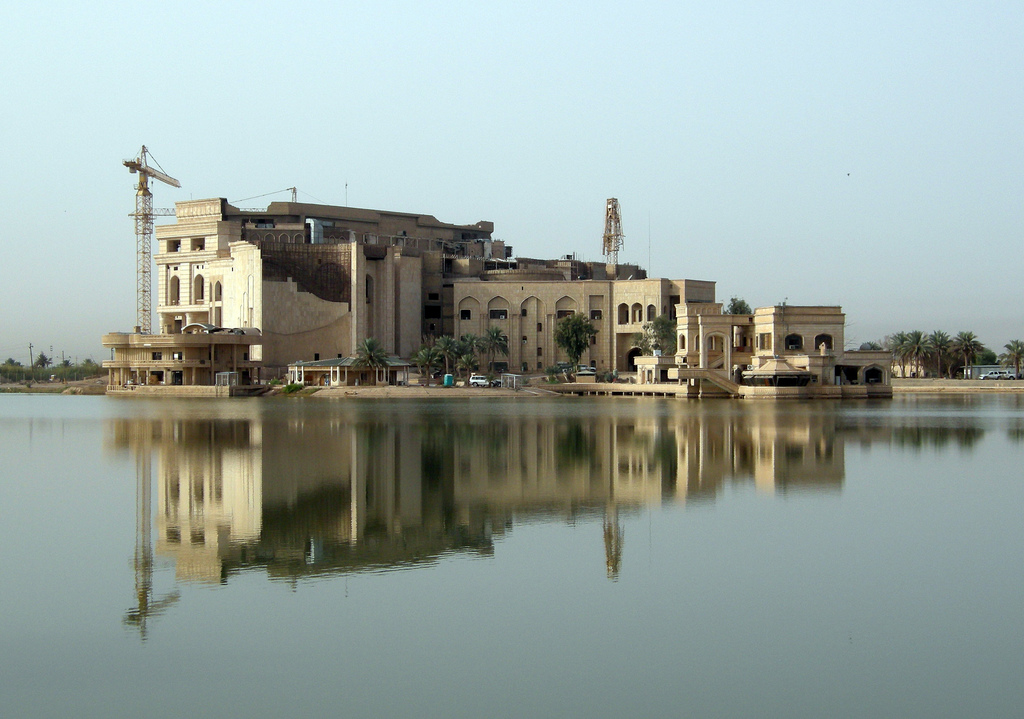
The Victory over America and Iran Palace.
Flickr/Brian Hillegas
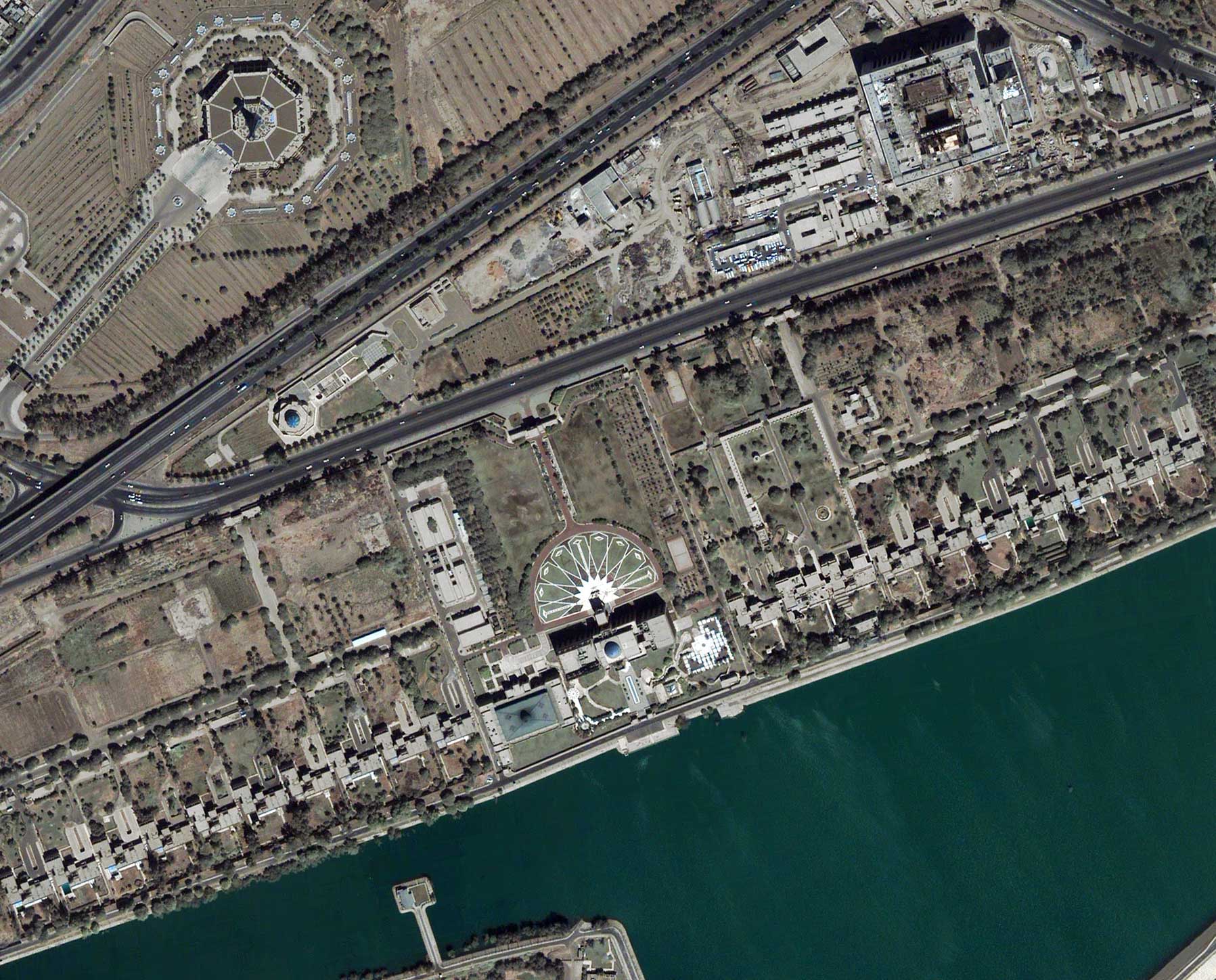
In the course of the twenty-four years in which he was in power, Saddam “built dozens of palaces” which the Deserted Places blog cites as numbering between “80 and 100 according to different accounts” across the entire country, from Tikrit and Mosul to Baghdad and Basra. The majority of these structures were built after the 1991 Gulf War. U.N. documents list “eight main [palace] compounds containing more than 1,000 buildings – luxury mansions, smaller guest villas, office complexes, warehouses and garages – and covering some 32 square kilometres in total”. They housed family members, ministries, government bodies (secret and ordinary), and political allies, serving both as residences and government offices. And this timing is important – as Owen Hatherley has argued, writing about the architecture of eastern bloc Communism, periods of crisis were almost always accompanied by an architecture that was the most brash, the most visually intensive. In times of anxiety and constriction, despots build. In the case of Al Sujud palace, that “anxiety” was expressed with an abandon of energy; satellite imagery taken in 2002 from a colour QUICKBIRD image, on September 10, reveals a large compound of gardens in which several large buildings are set, the “primary” palace topped with an Islamic blue dome which looks out over the Tigris. A peacock’s fan of sculpted gardens arches away from it. Look – not even closely – and you realise just how large the gateway itself is, at least a third the size of the main building. In 2003, the palace – formerly occupied by employees on Saddam’s staff, in a palace larger than Buckingham palace in London, was occupied by the Georgian military. The building had already been heavily damaged in 1998 by a U.S. bombing sortie, which had “penetrated the roof and destroyed the interior”. It was destroyed again in 2003, and was later occupied by the Ministry of Justice as well as hosting the trial of Saddam himself. It became known, after 2003, as Forward Operating Base Union, or FOB Union.
The palace’s typologies tend almost thuggishly toward a grandiose monumentality in both form and materiel; vast volumes of marble, heavy-duty columns, arches, and a richness of gold fittings support massive domes which overlook sun-drenched courtyards, dry gardens of grass and palm trees, and swimming pools. Their colours range from rose quartz to salmon pink, dusky lemon yellow to sky-blue and gold. Photographs taken by Richard Mosse reveal an inner world of vast atria lined with rolls and coils of shaped stone, black columns, masses of gold fittings, and rose marble. They look – cold. Unwelcoming. From the ceiling hang gaudy light fittings which resemble delicate, oversized baubles. Every effort has been made to maximise the richness of material and sumptuousness of space; to describe a power structure in which nothing but “the best” is permissible. Their murals, drawing on a long legacy of secular and religious Iraqi design, complicate their ceilings in a miniature fret-work of gold, red, green and blue.
One of my favourite images by Mosse depicts four large pillars, geometric in their volume and organisation, supporting a hefty ceiling of intricate painted designs and star-shaped mosaics. Beneath these a long, pasteboard wall has been stretched, reaching only half-way to the ceiling. A thin door of MDF offers access into the adjacent area, while two blandly grey air-conditioning units purr listlessly on the floor by its side. In striving for such power in their richness of materiel and design, any element which denies that – bullet marks, water staining, looting damage, or post-war adjustments such as electricity cables, generators, and MDF partitions – only serve to highlight the absurdity and contradiction of such spaces which resist, to the death, any association or implication with the mundane. This tallies with Andrew Mueller’s visit to one of the palaces in February 2005, which had been converted into a “canteen for the Iraqi police and British soldiers”. He noted the “fabulous superficial opulence of the palace”, an impression of overwhelming “cheapness”. Many writers who have encountered them go for the spectacular; “disused swimming pools, personal zoos/nuclear bunkers etc. Rooms fitted with thrones and gold lavatories”. This is all true, of course, but there’s scant discussion of the complexes from an architectural and social perspective. They are gaudy, but they are not insignificant.
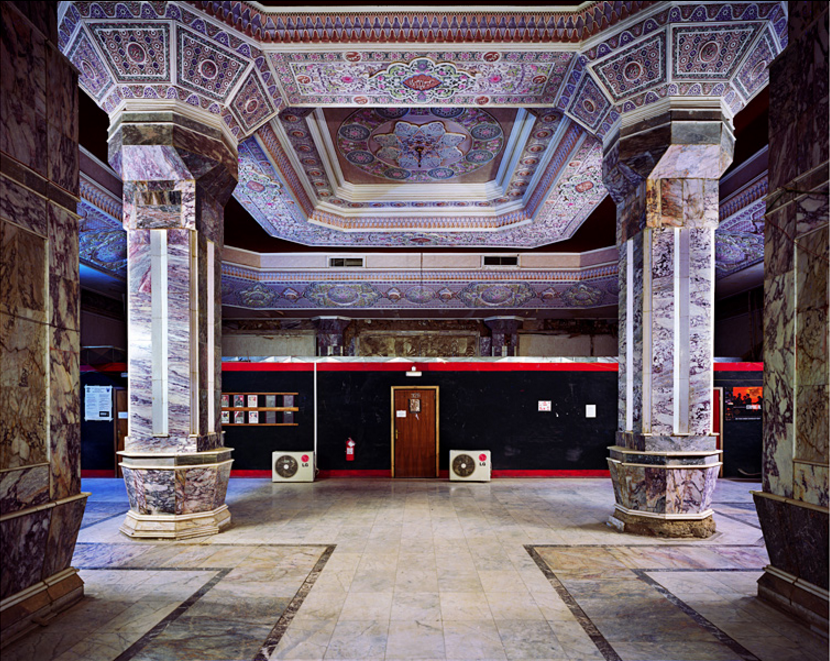
Richard Mosse
After Saddam was toppled in 2003, the so-called Coalition Provisional Authority (or, CPA), headed by American diplomat Paul Bremmer, was established to “guide” the transition of Iraq toward its first democratic elections. The palace estates – constituting the built environment of Saddam’s Baghdad – became one of their (probably unwelcome) responsibilities. It is difficult, however, to trace exact processes of decision making and discussion for all of the palaces, of what was decided to be “done” with them, and how. Some key structures were fortified and then occupied by temporary governance bodies and administrations, such as the Republican Palace (which pre-dated Saddam from the time of King Faisal II during the 1950s), which was used as the centre of the American diplomatic mission in Iraq. Others, such as the Believer’s Palace, had been all but destroyed during the air war which preceded the ground invasion. As Frank E. Wismer observes –
“it must have been a grand structure at one time, but it was [nothing] more than an elaborate hoax. The palace was built to disguise a three-story air-raid shelter located beneath it.”
The building’s once grand facade (or “edifice”, as he wryly observes) led to a lobby filled with smashed war debris and rubble, while its lifts, which descended to the undamaged shelter, were gaudy and sumptuous, reminding him of a “posh hotel”. The obscene fakery of the design, intended to hide a protective bunker away from the eyes (and bodies) of Baghdad’s ordinary citizens, clashes strangely with the vast and bluntly obvious blast barriers and concrete defences which have sprung up around the Green Zone since 2003, revealing a landscape of both hidden and glaringly revealed defensive structures which gesture, decisively, toward the paranoia and violence to which the city has been exposed over the past thirty years.
Structurally, the palaces often reference more conventional, religious and vernacular, styles of design. There is no international modernism here, but rather a stripped down combination of plain sandstone and detailed, often rococo, additions, yet in their harmony and use of wide archways, columns, and flat planes, there is an illusion at an attempt to modernise and update traditional architectural approaches. This also gestures toward the architect’s haste to ensure quick delivery, speed, and affordability. The style can be seen in older, mid-century structures such as the National Museum of Iraq in the Al-Karkh district, completed in 1966. Others have a dense massing of hard cuboid volumes – executed in the same yellow sandstone – which bulk and emerge from the ground on narrower columns and overhanging lintels. The square column is favoured over the rounded pillar. Arches are also prominent.
The As-Salam palace, a one-time residence of Hussein, is typical of this style, with its 93,000 m2 of floor space, six floors, ball rooms, and masses of granite and marble. The harmony of its plan can be seen in aerial imagery taken during the late 1990s, topped by a peaked dome. Many of the details on the front are not structural but decorative, embossed into the otherwise planar fields of sandstone; this self-conscious decorative approach to the facades illustrates that the buildings were intended to show-off the fact that they were intended to impress, and thus gain a certain post-modern currency in terms of favouring external decoration that does not reference internal spatial organisation. “Decorated sheds”, as Robert Venturi put it, though the sheds inside were dripping with marble, gold, and inlaid wood.
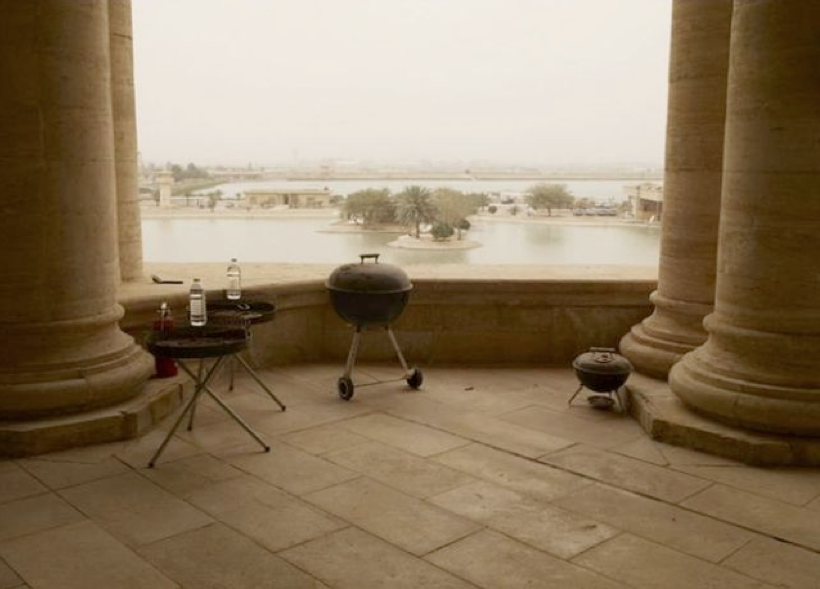
During a tour of the palace in 2003, one US soldier remarked, “this could make a pretty nice casino”. This reference to the American hyper-capitalist postmodernism of Las Vegas is appropriate, though most likely unanticipated by its designers. The gamble, however, seems to be America’s, not Iraq’s – as some commentators have argued, these palaces were not funded by Saddam’s own treasury but by the “oil for food” program and international tax money, to the tune of some $2 billion Dollars.
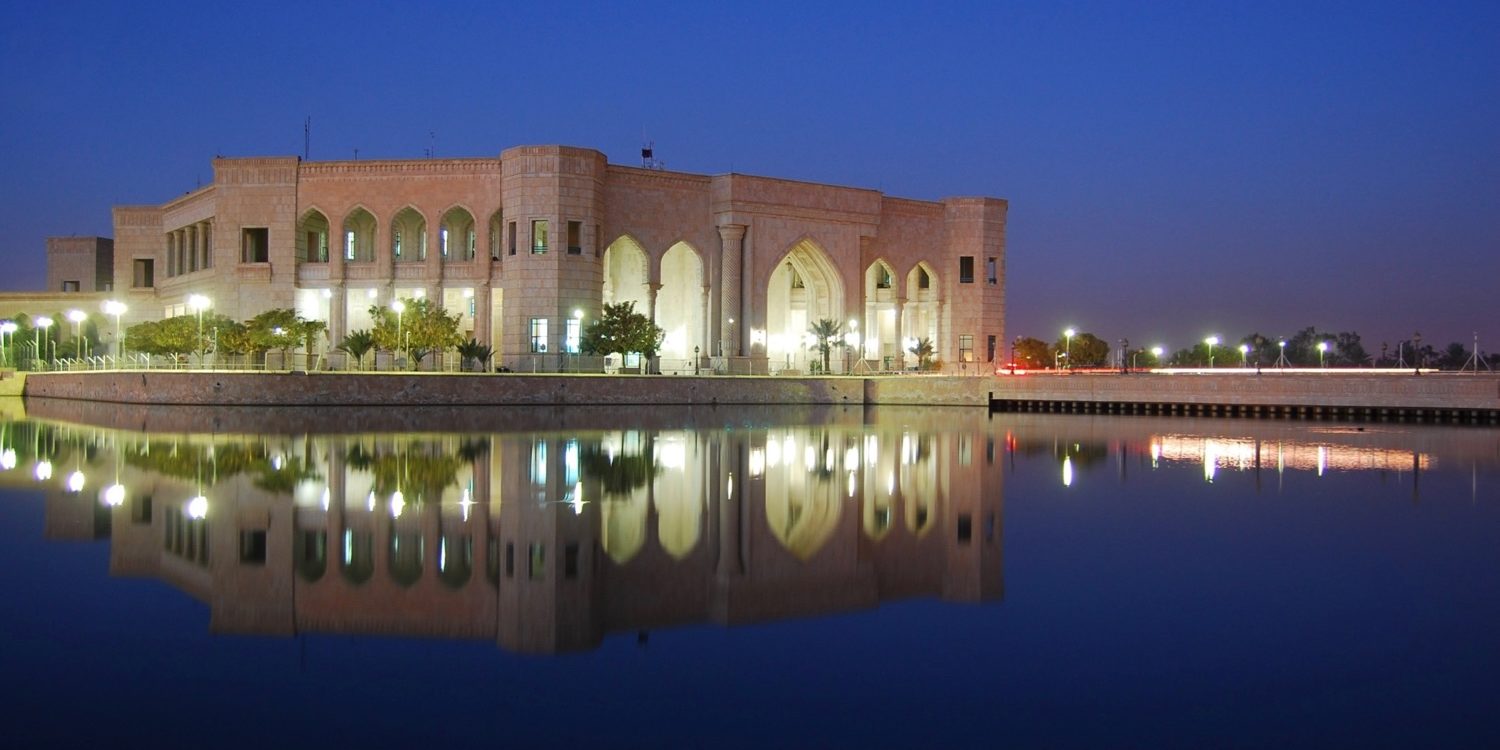
Other palaces display an imaginative range of Islamic and Middle Eastern architectural influences, often scaled-up to enormous and pendulous sizes. Iraqi architecture has always been fond of archways, curtain walls, and portals, seen even today in the international and “metaphoric architecture” of Basil al-Bayati. The palaces mix styles including those of the Qaṣr fortresses, Moorish “interior” or recessed arches, and the stateliness of Timurid (Turkistan) architecture, which make use of large portals and columns, as well as hard Iranian-style (or Persian) geometry. Arched portals, recesses, cuboid volumes, and elaborately harmonious structural plans with complex elevations typify an immensely dynamic architectural range that often focuses consistently on external spectacle and frontal elevation rather than formal subtlety. The block-like Abbasid style native to Iraqi Mesopotamia provided the perfect base on which to elaborate through excess. And this results in a diversity of final form – the chunky, brick-built mass of Radwaniyah palace contrasts with the mosque-like bays of seried arches which constitute the more restrained, but equally monumental, Al-Faw palace. It is a costume cupboard. A fancy dress costume overburdened with crowns. Indeed, the level of architectural parlante goes further in a very direct way when one compound (the “duck palace”) was created “in the shape of the Al Faw complex”, in an act of a palace aping another palace, disappearing the sign into the signifier completely. This one had 62 rooms and 29 bathrooms, and was intended to host fowl shooting parties.
Their interiors – grossly eclectic in their range and styles – borrow even more loosely. Obviously, there are exceptions, and it is difficult to generalise too broadly when confronted with a number of structures that function like so many authoritarian lynch-pins in the urban texture of the city. For example, to see photographs of their interiors it is evident how much the “procession” was emphasised; the bomb-damaged interior of the palace at Jebel Makhoul includes an internal, two-storied octagon space surrounded by pillars and topped by a dome, shedding light into the space below. Visitors, at its height of splendour, must have wandered in through the main portal to be confronted with this sudden expansion of space around them. It is not subtle. But nor is it intended to be. Of course, there are serious questions regarding their structural integrity due to poorly salianted concrete. More than one visitor has described being able to lift marble tiles literally off the walls. Clearly, this begs the question of whether efforts should be made to preserve them. If so, why? Why retain structures that – as Colin Freeman suggests – Baghdadis used to literally avert their eyes from in hope of unseeing them. In letting them rot, will something important be lost, or will it provide a means to let a legacy of oppression die with them?
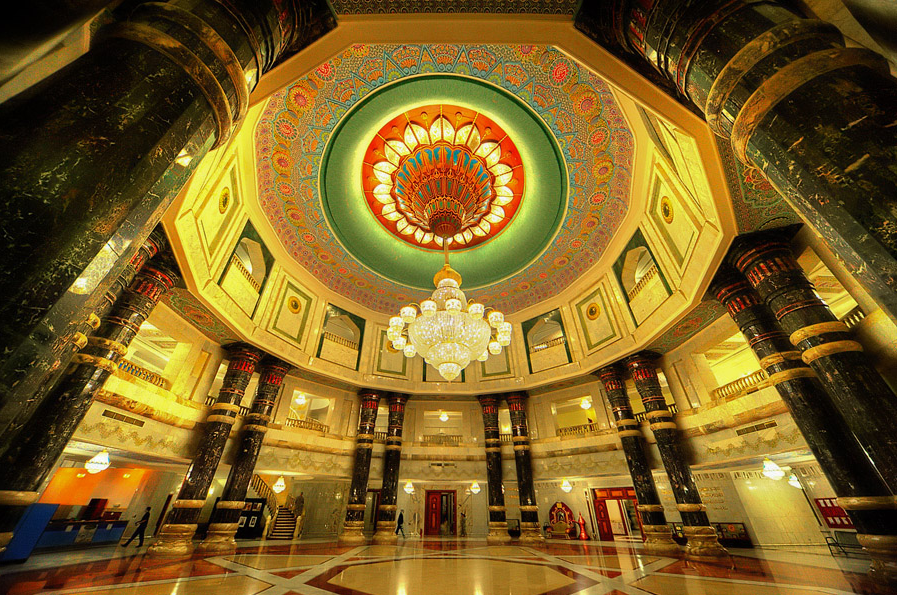
But when reading about the palaces, from eyewitness testimonies, interviews with former generals and Iraqi aides, members of the CPA, journalists, and soldiers, the palaces appear and disappear in defiance of their formidable size and strategic value. They are not easy to track, as if eyes – and minds – are still averted. Luke Baker’s account of his time spent as a journalist in the city after 2003 accounts, on several occasions, of “the palaces”, or of “one of Saddam’s former palaces” which he later describes as a “vast complex of ostentatious palaces, several destroyed by U.S. bombing, that the dictator had built on a high bluff overlooking the Tigris”. Without setting foot in the contested city, we can parse such documents, reportage, and hand-held video footage, to gain a glimpse into a massive yet illusive and awkward infrastructure of compounds, some of which were obliterated, others captured, others abandoned. One account of the invasion itself recounts how the 3rd Infantry Division (U.S.) “captured one of Saddam’s palaces”, yet fails to identify it by name, or location. You get the creeping sensation that, so numerous are these structures, that it’s almost irrelevant or wasteful to refer to them as independent structures. The CPA, famous for its quasi-dictatorial-cum-Neo-liberal and oblique oversight of the country between 2013 and 2014, seems to have had no comprehensive strategy for managing the palaces, their preservation, function, or oversight. Many were looted. Others have been left to rot.
This is a strange state of affairs when you consider how the palaces have always played a decisively political function – not simply to communicate the regime’s excessive wealth and privileged consumption, but as an instrument of foreign policy. Before UN Weapons Inspectors were allowed into Iraq in 2002, the palaces were “off limits”. Eventually, ten locations were opened for the inspectors to survey and investigate. But in 1997, a group of Western journalists had been given earlier, privileged access to six of the presidential palaces, “with landscaped lawns larger than 10 soccer fields”. The then Deputy Prime Minister Tariq Aziz, leading the tour, remarked that the Iraqis wanted the journalists to see the palaces “where many mysteries have been fabricated about them, so you can see yourself that these are normal presidential sites”. A CNN reporter uses the word “affable” to describe this slick, schmaltzy PR episode. The UN used stronger terms.
Technically, these sites – in various states of occupation, repair and disrepair – now belong to the Iraqi government, whose plans have involved everything from a mixture of re-purposing (using the buildings for administration), to managed decline, in which the palaces – secured with perimeters and security – are allowed to slowly crumble. A recent report in Daily Sabah suggests that
“the Iraqi government has considered selling off palaces and other Iraqi estates built under the regime of overthrown leader Saddam Hussein, since the economy is struggling with an economic crisis exacerbated by the collapse in crude oil prices, the corruption of public institutions and the fight against the DAESH terrorist organization.”
Masud Haydar (a member of the Iraqi Assembly’s Financial Committee) “confirmed that the suggestion to sell state-owned estates and palaces […] has been presented to the government”. Whether or not this will come about is unclear, for many of the palaces – they suggest – have been “confiscated by political leaders”. It’s not impossible to suppose that the compounds have become detached from Saddam’s own legacy and are seen instead as a resource for the country’s political leadership, regardless of the type, or ideology, of its government.
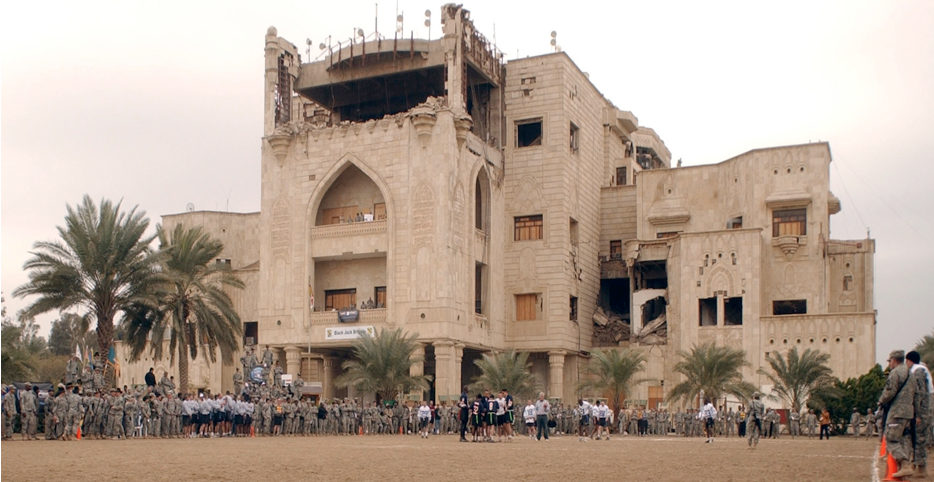
In contrast, figures such as economist Ali al-Tamimi have suggested that, “instead of selling these palaces, turning them into museums might result in a more stable and long-term income for the government”. This is a solution which reaches beyond the economic – the palaces, and indeed much of the built legacy of Saddam, is highly sensitive as Baghdad property. In 2003, Bremmer had to awkwardly face down accusations that his “Christian” transitional government (as it was seen) were desecrating the palaces of the country’s (then still living) leader by their presence.
An article written on 22 April 2003, not long after Baghdad fell, is filled with ricocheting observations and an almost feverish excitement with the palaces, as the journalist accompanies soldiers, architects, and speculators around the buildings. One property mogul excites as the opportunity “to list” the buildings in a luxury property guide; another suggests that they should become “museums for the prevention of bad taste”. They continue –
“as Iraq’s economy revives, some of the palaces could also become lavish homes for foreign investors or titans of a new capitalist class. Many have man-made lakes and spectacular gardens; some sit on the banks of the Tigris River, while at least one overlooks the ancient city of Babylon. All are surrounded by walls that ensure maximum privacy and security.”
After 2003, the status of the palaces reflects this uncertainty; in 2012, Nouri al-Maliki, the prime minister, instructed residents of some palaces to evacuate the properties in order to allocate them “for culture and arts exclusively”. Only a year earlier, the former Presidential Palace in the Aathamiya district came under regular mortar fire. It was occupied by the Iraqi army. The palaces are castles, targets, galleries, and offices. Collectively, this points toward a lack of coherent policy toward resolving what will be “done” with the palaces as infrastructure, real estate, and architecture. Already, the experience has begun to be commodified; some palaces levy entrance fees, offer visitors the option to purchase dates from Saddam’s own trees, and offer up hotel rooms for as much as £150 a night. The opportunity is immense, yet the engagement is limited. As one Iraqi tank commander later asked; “you people in Europe have kept all the castles of your bad guys, so why shouldn’t we?”. He has a point.
Should Baghdad’s “mythical” palaces slip back into private ownership – as houses, offices, and hotels – an opportunity will be lost to engage the city’s long-suffering population with their recent past. No opportunity to ‘talk’ to that past will come about. Since 2009 and American withdrawal, these questions have arisen time and time again; what to do with them. Of course, the solution doesn’t have to resemble a perfect redevelopment of these deeply divisive buildings, but must at least communicate with and consult ordinary Baghdadis over the fates and uses of this immense, albeit secretive, private infrastructure. Should they become private hotels, offices, and government departments, an opportunity will pass away. Within this scope, a museum – or, museums – might not seem such a far-fetched idea, yet it relies on placing public interest over private, personal gain, and of negotiating the political and economic rapids of tumbling oil prices and domestic terrorism. If the palaces are allowed to become only post-modern casinos or elite residences, another opportunity to confront and “make visible” a history of internal and external, domestic and international, violence against a population will be missed. An architecture after excess is possible, but it is not easy.
Top image: Al Faw Palace, Flickr/Art La Flamme