This article is part of the FA special series Everywhere Walls, Borders, Prisons.
Images of people sleeping on the floors of waiting rooms and in tents provisionally pitched on lawns. These are the sensationalist images people most associate with the rural town of Ter Apel, where the Netherlands’ largest asylum seeker centre is located. Ter Apelervenen caused much debate in the winter months of 2023 and 2024 as people fleeing the wars in Syria, Somalia and Ukraine sought refuge in the Netherlands and the facility ran over its official capacity for months on end.
The Red Cross issued warning after warning about unacceptable conditions on site, but instead of focusing on the humanitarian core of the situation, Dutch politics decided to home in on the issue of family reunification in the context of migration law, as if amending that law would do anything to alleviate the number of people adrift in a world on fire. At the time of writing, two governments have fallen over the issue, first in 2023 and more recently in the summer of 2025.
As deep into the rural North as the geography of the small country allows, Ter Apelervenen’s isolated location could not be more inconvenient for the refugees who have to register and regularly report there. Even from the nearby city of Groningen, a trip by public transport takes two hours, and to get there from the political and economic centre in the west of the country would easily take two more.
This ex-centric and remote location was a boon during the Cold War. Because Ter Apel is so close to the German border, a NATO depot was opened there in 1984, despite significant anti-war protests. This way, NATO could easily set up a military supply line into Germany in case either Germany or Russia would challenge NATO’s global ambitions for the liberal-democratic trade zone it had established in post-World War II Europe.
Ten years later, when the threat of the Cold War dissipated and the NATO complex was closed down, its strategic location became one of problematic isolation because the local population relied on it for employment and had few other options in the region. In 1995, the government therefore chose to use part of the complex as a refugee centre to ensure local livelihood, but without apparent consideration for what this poorly connected location may come to mean for the people who were envisioned to stay there.
In 2014 and then again in 2017, it was revealed that both former NATO employees and current employees at the Central Agency for the Reception of Asylum Seekers at Ter Apelervenen disproportionately suffer from health complaints like bloody noses and cancer. Whether these symptoms are caused by the fact that the site had been used to dump industrial waste in the period before NATO settled there, by NATO’s use of Chrome6 paint in the maintenance of tanks, or by the alleged dismantling of leaking nuclear warheads from the First Gulf War at the site, is difficult to prove.
Government reports state that the site is not unduly polluted. None of the materials on this topic mention how these health hazards may affect the more than 2000 people living at the facility at any given time, depending on the duration of their stay.
Ter Apel functions like many contemporary hinterlands – areas implicitly or explicitly seen as existing in service to a given political centre’s preoccupations. In this centre-periphery scenario, hinterlands are not a natural phenomenon, but are actively produced by the centre’s perspective on the world.They are used for extractive processes like mining and intensive agriculture, waste management, fielding the mind-numbingly repetitive infrastructure of Capital’s logistical processes, or, in this case, housing so-called unwanted populations on the back of a former military supply chain.
At the same time, precisely because they harbour these crucial but often unattractive, unpopular or sensitive processes, hinterlands tend to be overlooked as inconsequential and uninteresting. In this way, as Brenner and Katsikis note in their essay “Operational Landscapes”: “the hinterland itself has remained something of a ‘black box’: metabolic flows move in and out, but what actually happens ‘inside’ the box, and how the latter has itself evolved, are [sic] not interrogated”.
Historically, the municipality of Westerwolde is known for its isolation because it was surrounded by peat bogs and suffered from poor soil conditions. soil It was altogether abandoned in the course of the Late Iron Age (c. 1200 – 550 BC) and only sparsely inhabited during the early Middle Ages (c. 500 – 1000 AD) until, in the late Middle Ages, Westerwolde came under influence of the Catholic Emsland region. This led to the founding of the monastery in Ter Apel, which remains the town’s most important attraction today.
During the Dutch Republic period (1579 – 1795), Westerwolde was generaliteitsland, which meant that, along with a number of other regions under Catholic influence like Brabant and Flanders, the area was controlled from the Protestant centre (the Staten-Generaal) but did not have its own voice in the seat of power. These generaliteitslanden functioned as a military buffer zone between the Netherlands and the neighbouring Habsburg and Spanish territories. They were also economic wingewesten (lit. gain areas), of little interest apart from their raw materials and potential for labour extraction.
Often historically entwined with extraction, warfare and imperialism, hinterlands tend to breed a politics of abandonment. As operational landscapes, hinterlands are used, but not supported. They do not seem to qualify for infrastructural development or basic services like public transport and health provisions unless these factor into improving the function of the hinterland for the centre and those thought to belong to that centre. Jan Schipper, one of the former NATO employees suffering from health issues, described this dynamic succinctly in 2017: “It’s starting to dawn on me that people think they can pull all sorts of tricks in the North” (Ik heb de laatste tijd zo een beetje in de gaten dat in het Noorden alles maar kan)
A change in perspective on what hinterlands are and what they are for is therefore needed, so that their crucial but unacknowledged role in global processes can come to light. In what follows, we attempt to avoid reinforcing the sensationalist imagery around Ter Apelervenen in Dutch media and to work towards a perspective from the hinterland rather than reproducing the usual views on it. We place our lens, not at the bustling front of the facility that sees people coming and going all day long, but in the middle of what remains of the NATO site next door. This perspective shows what is hidden in plain sight, condensing the normally “black boxed” asylum chain into one surprisingly surveyable landscape that connects global infrastructures of war with national preoccupations with asylum and confinement.
Robert Glas, March 16th, 2025.
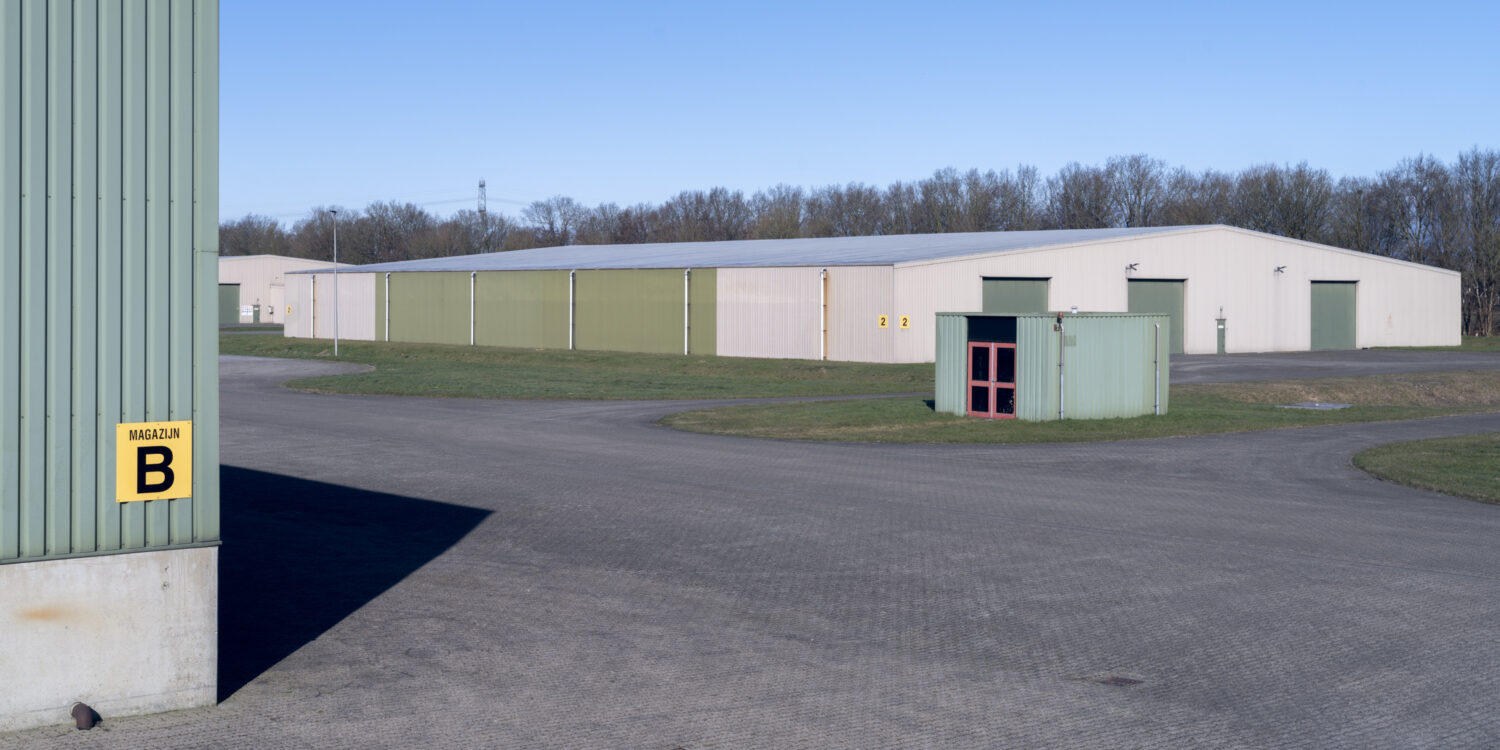
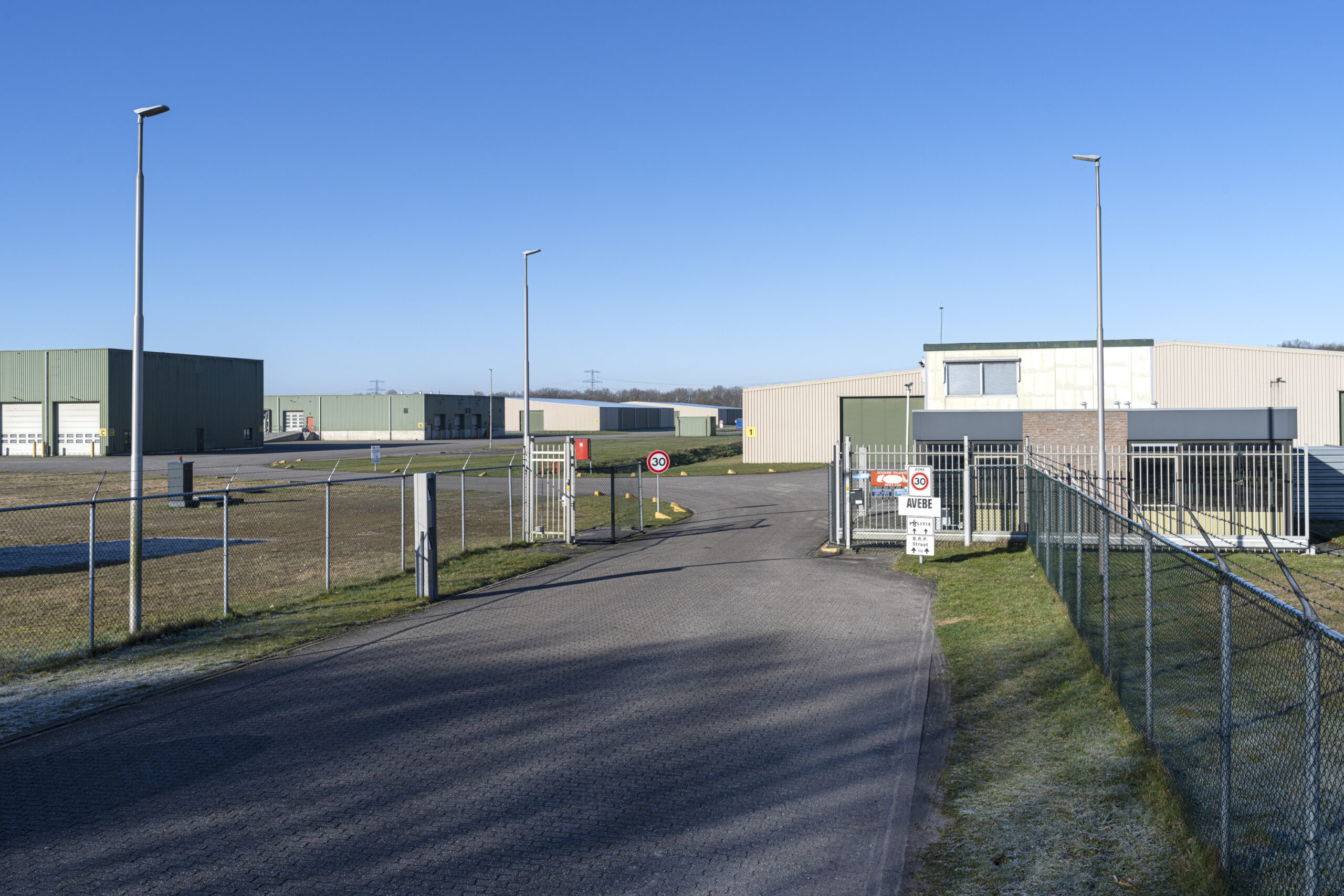
Arriving at the entrance gate to the former NATO grounds by car, a sense of confusion takes hold. All the fencing around the compound is intact, including a guard house with tainted windows that seems ready to be used at any given moment, but the grounds look utterly deserted, even for the tail end of a Saturday afternoon. The gate is open. The fence sports the signs of two businesses that are housed in the hangars in the background, yet there are also two “no trespassing” signs, one of which states the presence of guard dogs. Just behind the fence, two more signs point to a police station and to a Personal Records Database (BRP) registration lane, where refugees report themselves and are given a Dutch registration number. We wonder whether we should drive up to the guard house to make our presence known or whether we can just drive up to these businesses and see if there is anyone around to talk to. Maybe driving up to the BRP lane is a form of trespassing and if it is not, why is this fence even still here?
The sky is unusually blue, at least for Dutch standards. Although the original NATO colours have faded, the hangars are in good shape. The grass is short and well maintained. The paving looks clean and rodent traps are nestled along the walls of some of the hangars. What is being stored in the hangars is unclear, but some have signs that warn of chemicals and forbid photography. The drainage channels contain sludgy, brown water. This is a sleepy infrastructure, an infrastructure that seems to be waiting to snap back into purpose, even if that purpose is not yet clear.
Despite the rodent traps, the eerie quiet of the site is at least good for wildlife, even if its toxic nature is not. We spot a bellicose pheasant (who attacks his reflection in the tainted windows of the guard house), a white heron, several wagtails, crows, oystercatchers, and even two mating buzzards. As we stay longer, some cars and white vans intermittently cross the grounds on their way to the registration lane. Following suit, we also drive across the grounds, stopping at the BRP lane on the way back, where our inquiries about what the lane is for meet with quiet disapproval.
Robert Glas, March 16th, 2025.
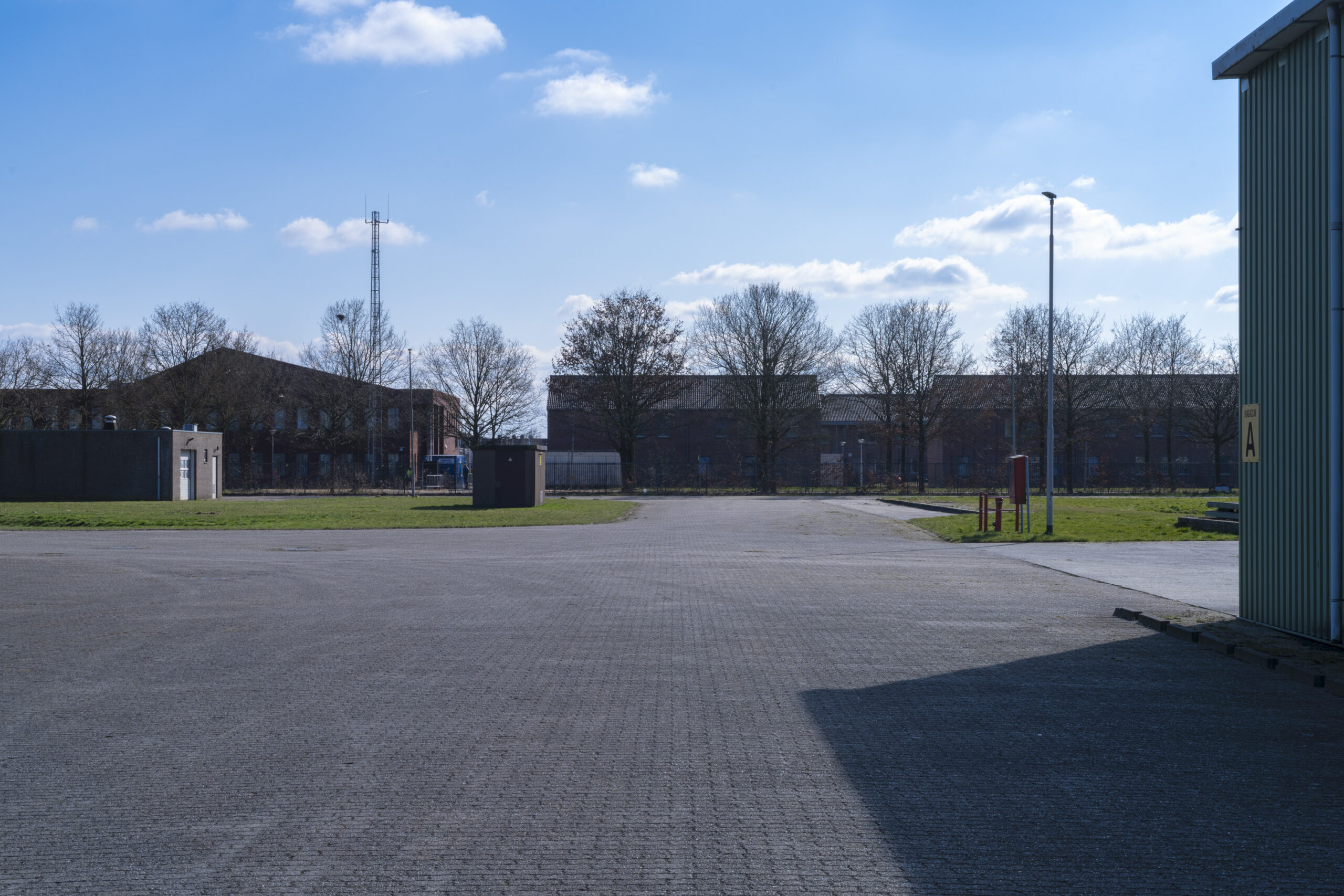
We end up back at the middle of the grounds and from this vantage point, we look at the asylum centre Ter Apelervenen from the side, straight at the residences and the strategically positioned security stations that serve to keep the site safe for those who live and work there. When we turn to our right, facing back towards the BRP lane, we see different forms of land–use stacked one behind the other.
Robert Glas, March 16th, 2025.
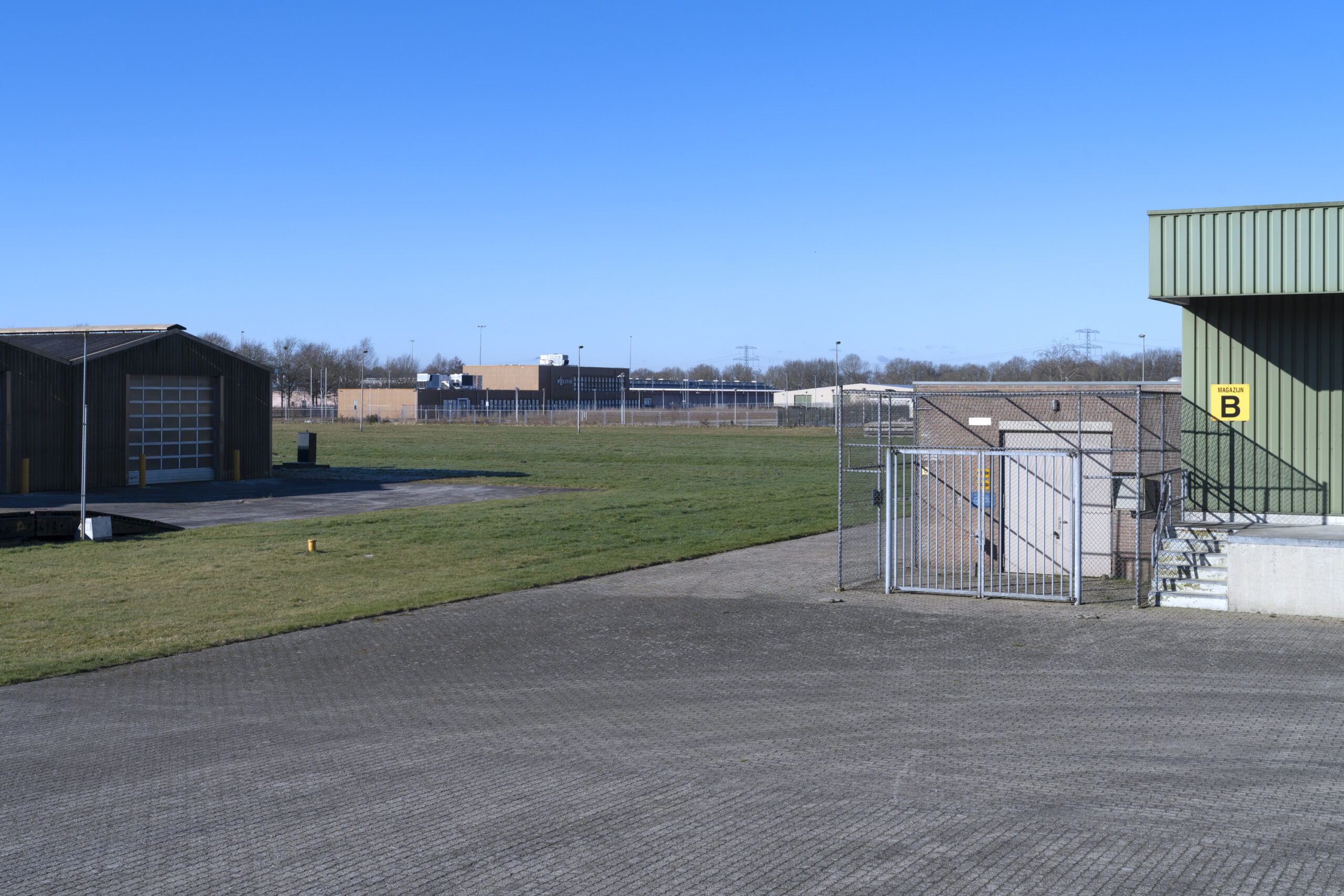
In the photograph above, the eye is drawn past the former military storage and maintenance structures standing in the wings in the foreground of the image. The police station that houses the Dutch Immigration and Naturalisation Service (IND) sits in the middle ground, along with part of the BRP registration lane to the right of the police station (only the bins at its back are visible). In the far background we see PI Ter Apel, a penitentiary designated for “foreigners in the criminal justice system” (Vreemdelingen in de Strafrechtketen, VRIS). That is to say, it only houses people who are not given a residency permit or who have committed a crime and have lost their residency permit as a result and prepares these groups for leaving the country.
This bocage landscape, which is traditionally used to lend depth to bucolic or idyllic scenes, now showcases the carcerality of the entire Dutch asylum chain: from reception, registration, and residence all the way to incarceration and deportation, all eerily bracketed by the sleepy infrastructure of NATO’s suspended military supply line. The image avoids both the spectacle associated with the representation of asylum processes and the emotional distance produced by the technologies of aerial photography. Instead, it documents the asylum chain as an efficiently organised space in step with the hinterland’s primary logistical function that exposes “territories and communities to increasing turbulence, risk and precarity, while systematically degrading the ecological preconditions of both human and nonhuman life”, to quote from Brenner and Katsikis’ essay again.
Why the well-maintained fences, guardhouses and hangars from the NATO era were not torn down is unclear. After all, they just sit there, quietly, surrounded by Ter Apel’s other hinterland infrastructures: the elaborate asylum facility directly on its south perimeter and large tracts of agricultural land on its other sides. As if to say, “move along, nothing to see here.” The site is freely accessible, yet it relies on threats about trespassing, as if it does and does not want to be seen at the same time.
With this ambivalent, yet unabashed visibility, the NATO grounds allow for an uncanny view on the asylum chain that undoes Ter Apelervenen’s front stage role in the construction of a national(ist) gaze. A perspective located on the grounds themselves shows how infrastructures of military logistics and population management seem to be interchangeable and available for recycling and upscaling, depending on current demand.
With a sense of path dependency and the necessary modifications, a strategic node in a global military supply line can clearly be turned into an asylum seeker centre that deals with global imperialism’s impact on the national level. Once such an infrastructure is in place, it will continue to script other purposes that suit its characteristics of controlling populations and goods. Which is to say, an infrastructure housing the deadly life of logistics can never be innocent when it can be so easily repurposed to more explicitly violent ends. In this logic, an asylum seeker centre containing one of the Netherlands’ bleakest prisons exclusively reserved for people with a foreign status, could, if global politics give rise to a need to defend European or national borders, turn (back) into a military facility or worse.
Though difficult to digest ethically, perhaps it is a good thing that the materials from the wooden barracks at nearby Westerbork were, with time, dismantled and repurposed in barns across the area. This seemingly blunt, unthinking and pragmatic approach cleared a significant part of the site from its infrastructures of control and freed the space up for commemoration rather than re-use. This worked rather differently in the case of the sturdy, brick infrastructure of the concentration camp built by the Germans in Vught during their occupation of the Netherlands in the Second World War, which is, perhaps unsurprisingly, still the location of one of the Netherlands’ two maximum security prisons.
It is too soon to tell whether Ter Apel will either proceed down the carceral continuum or snap back into the military supply chain if the war with Russia expands beyond Ukraine. Perhaps it will become the sink for yet another hinterland operation supporting national politics or global supply chains. It might at some stage even mercifully collapse into proper disuse.Either way, though, the grounds do not feel like a quirky remnant of the Cold War era, but rather as a threatening witness to the violent potential of the unapologetic but often overlooked economic, political and environmental role the hinterland plays in the globalised present.