This article is part of the FA special series Everywhere Walls, Borders, Prisons.
Author’s note: This article focuses on how the Latvian government is responding to refugees trying to enter the EU. The authors of this text recognise the role of Belarus in the crisis – specifically Lukashenko’s orchestration of the crisis and the abuse of refugees on the Belarusian side of the border.
To many Eastern Europeans, the year 1991 is like a beloved partner’s birth year. It was a year of new beginnings, as 15 countries joyfully declared independence from the Soviet Union. It was not exactly known what would come to pass between the former sister republics, but few foresaw the forthcoming border checks and divisions that would come to characterise their relations.
In 1994, two of these sisters, Latvia and Belarus, started to demarcate the length of their shared border with visual markers such as poles, stones, and signs. Seven new border controls were introduced. Slowly, the border materialized from an invisible legal boundary into an imposing physical presence. In 2004, Latvia joined the European Union (EU), marking a tipping point in the nation’s slide into fortress fascism, as this alliance required further militarization of the border with its eastern neighbours. Latvia joining the EU meant integration into so-called Fortress Europe, a xenophobic regime that normalizes the creation of life-threatening circumstances for migrants. An immense flow of migration started in 2021, after the Belarusian dictator Lukashenko issued a large number of visas to push migrants into EU countries, as a counterreaction towards numerous EU sanctions on Belarus. This involves using pushback, the act of forcing refugees back across borders, often through the use of force. This has resulted in an ongoing humanitarian crisis, and by March 2025, 148 border deaths had been documented across Belarus, Latvia, Lithuania and Poland.
Due to the Russian invasion of Ukraine in 2022 — and the ensuing humanitarian crisis — Latvia has been further militarising its border strip. The strip is a 2 km-wide area along the national border where entry is allowed only with a special permit and is strictly monitored by border guards and surveillance systems. Latvian authorities have constructed border walls, surveillance towers and anti-tank barriers along with many other architectures of control throughout this strip, threatening to erase anything that isn’t part of the military. While vital for defence against aggressive neighbours, these structures divide and fragment the lives of local communities and makes seeing family or friends on the other side of the border impossible. One of these border communities is that of Piedruja(LV)-Druja(BY), a border village that is split by a river and located entirely within the border strip.
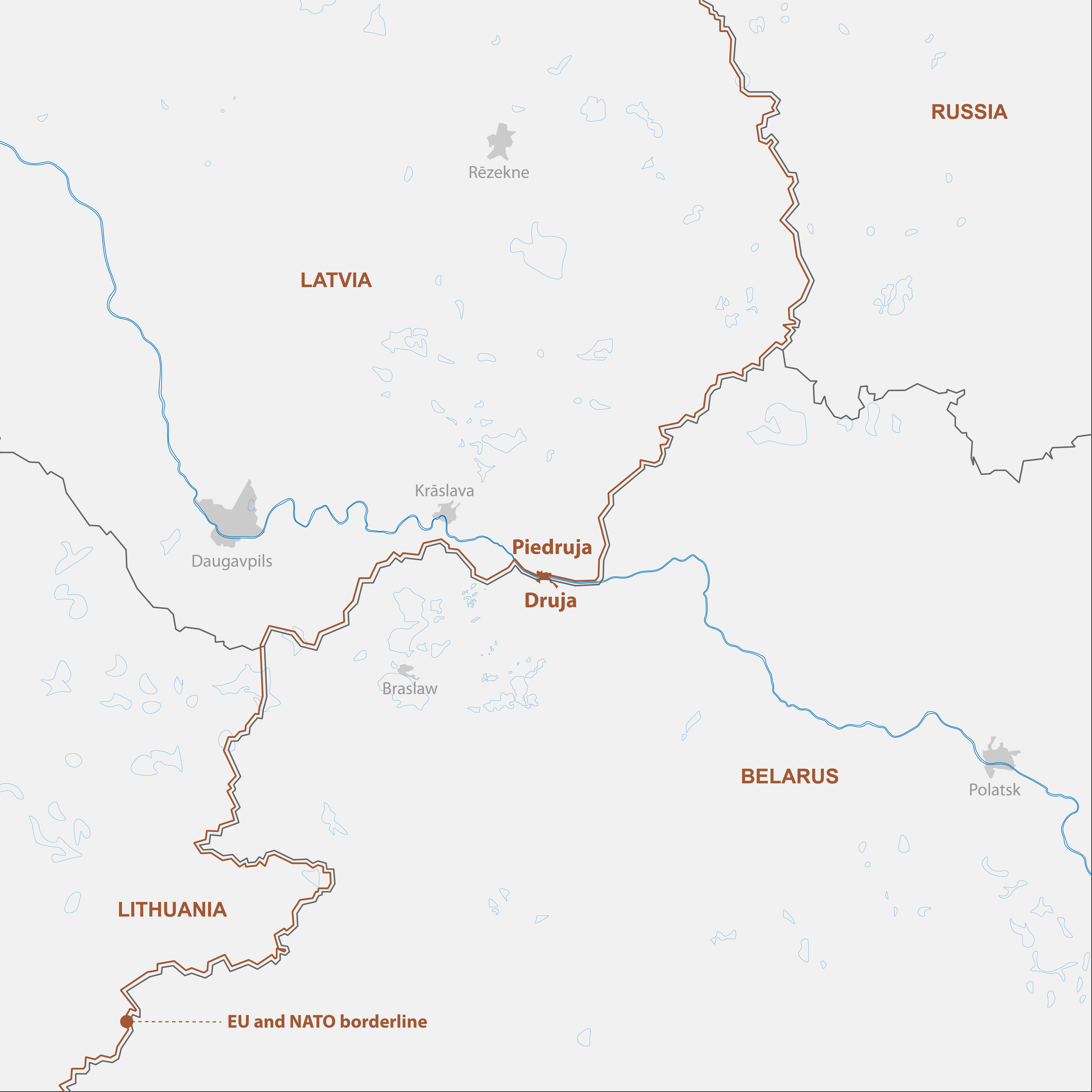
Latvia-Belarus border
Danute Līva and Darya Akhrameika
This essay is part of an art project, Piedruja–Druja by us, Danute and Darya. We have been researching and visiting the LV-BY border area since 2024. Our collaborator is Anna Griķe, an anthropologist and activist, and a member of a Latvia-based NGO I want to help refugees. Anna has shown us important sites and provided insights about the ongoing crisis.
The border between Latvia and Belarus is about 173 km long, with approximately 16 km running along the middle of the Daugava/Dzvina river where it crosses the village of Piedruja-Druja. Historically, Piedruja-Druja has been repeatedly united and divided along this river under different regimes, a history that is ever-present in the identities of village locals.
The most recent moment of unification for the village was during the Soviet period, with a ferry and boats ensuring fast daily connections across the river, which is about 190 meters wide. Unlike today, the river wasn’t an obstacle, but something that was shared and belonged to the village’s landscape. In the 90s, water tourism was popular in Piedruja-Druja, where many tourists went rafting and locals loved to fish for catfish. Visiting the other riverbank was as casual as going to a nearby corner shop. Locals crossed the river to go to school or church, to attend parties, or to visit the cemetery. The river has an island about 1 km long which used to have footbridges leading to it, its beaches serving as a meeting point during hot summer days. Locals celebrated Midsummer and Maslenitsa on the island.
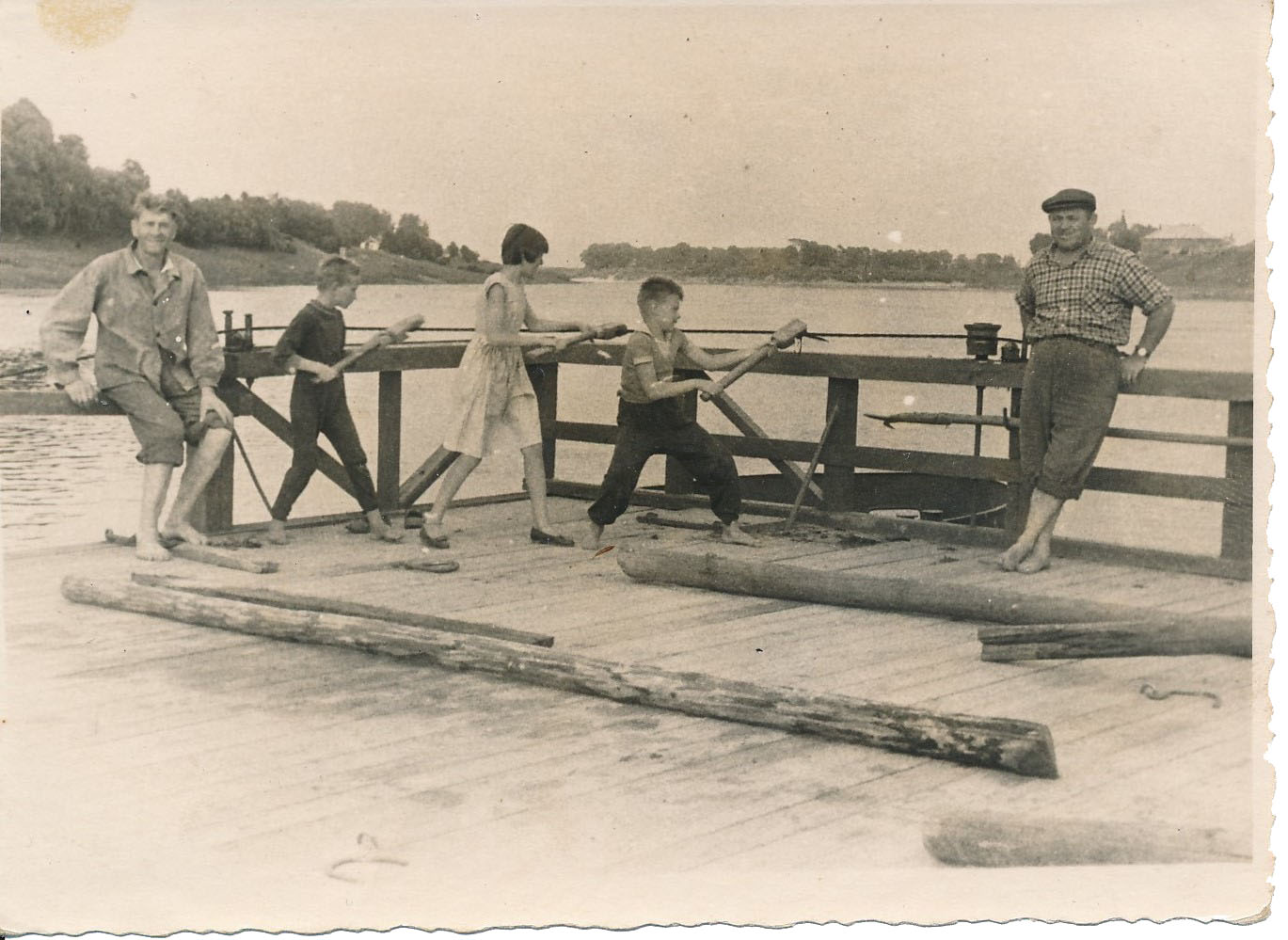
Ferry in Piedruja-Druja, 1960s
Krāslava Museum Collection
The village originated on the Druja side and organically grew across to the opposite bank. Locals yearn for the days that the journey across was a question of minutes. Now it requires two border checks, visas, and a two-hour car ride. As the river was militarized, locals were forced into long-distance relationships.
Division brings about new connections: the Daugava/Dzvina river has been used to smuggle drugs, alcohol and in particular, cigarettes from Belarus into Latvia. This smuggling route involves bribed border guards and a network of locals, many of whom turn to contraband due to a lack of social security. People often come up with creative ways to transport cigarettes across the river, like making blocks of them that resemble sheets of ice. The island in the middle is now Belarusian territory, and access to it is restricted to all nationalities. Yet, it continues its legacy as a meeting point, now for low-amount trafficking of cigarettes, weed and vodka.
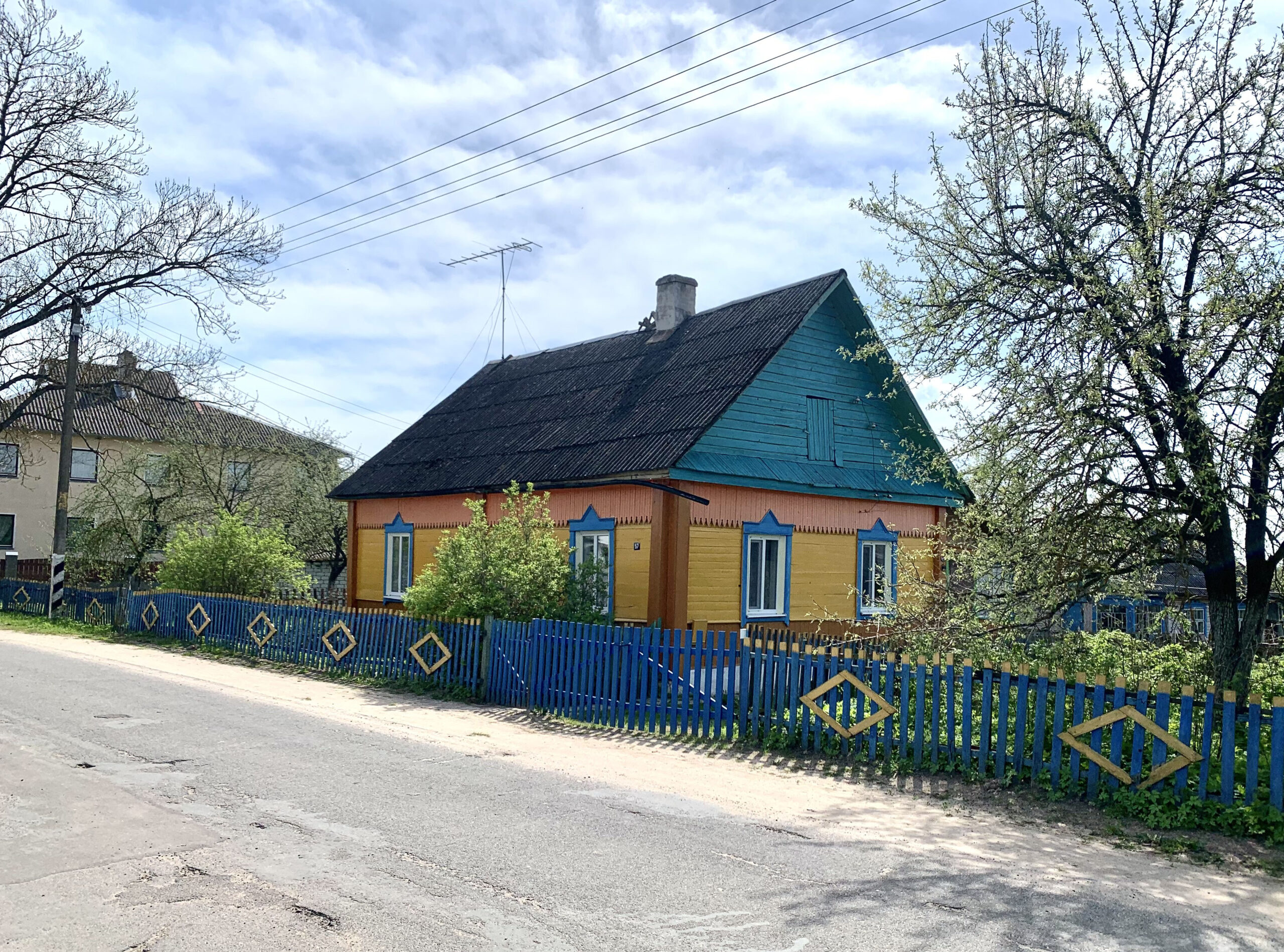
House in Druja, 2024
Danute Līva and Darya Akhrameika
In Piedruja-Druja, the border poles, surveillance towers, wall, trucks, anti-tank barriers, cameras and border controls serve as constant reminders of the government’s attempt to conceal the daily violence enacted against refugees. Access to the border strip is restricted to those with a special border pass. Such passes are generally granted only to white Europeans who show no interest in the ongoing humanitarian crisis. Those who find themselves within the border strip are legally required to report any migrant they encounter, and are prohibited from providing aid. Independent journalists are barred from investigating the abuse carried out by border authorities within the strip.
In August 2025, Ieva Raubiško was the first activist who was found guilty of helping asylum seekers in Latvia. Her sentence was 200 hours of community service. Latvia’s criminalisation of humanitarian aid is a dark cloud on the horizon, a sign of an authoritarian state under which it is unlawful to give another person a glass of water, as the state sorts acts of care into “legal” and “illegal” actions.
Today, Piedruja-Druja is a dream territory for the surveillance state, where locals and visitors are constantly self-conscious of their own movement, and where border guards are the new nobility. Those whose livelihoods depended on tourism have lost their income, and many have moved away. In 2024, the border strip had the highest population decline in Latvia. Remaining locals are used as pawns in the government’s game, left to live in a socio-economically dying area.
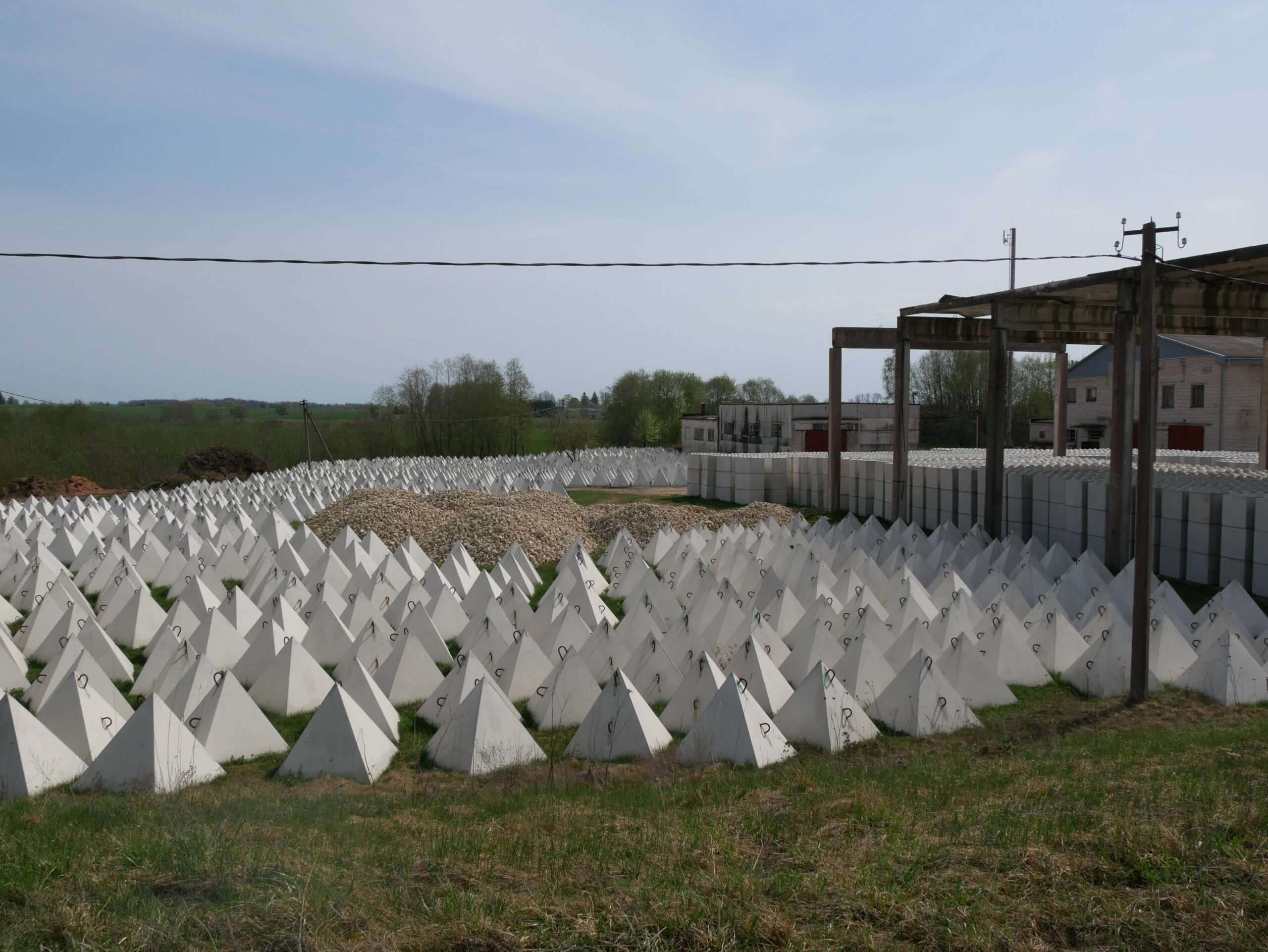
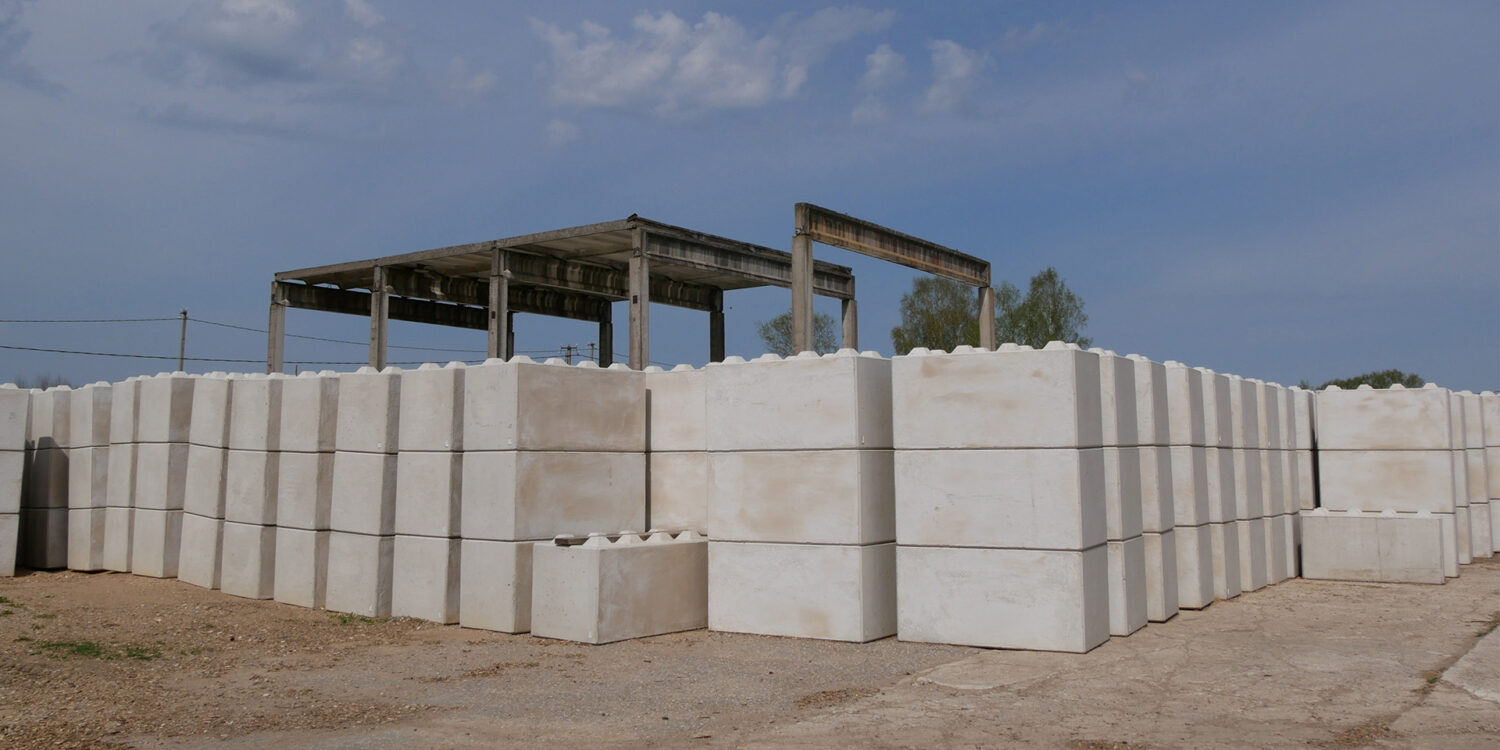
Anti-tank barriers (dragon’s teeth and modular concrete blocks) in Piedruja, 2025
Danute Līva and Darya Akhrameika
To make room for militarized structures, the government has cleared and relocated cultural sites from and within the border zone. As a result, militarised areas are hidden from view as residential and sightseeing activities take place elsewhere. A beloved gathering place for locals called 7 Chairs — a small stage, a barbecue area, and seven oversized chairs — will be moved to the village centre to make way for a new surveillance tower, the location chosen for its clear view of the landscape. Cultural history is erased, as the area is transformed into a site for surveillance and pushbacks.
The final nail in the coffin for Piedruja is the ongoing construction of a border wall along the river. It will completely cut off access to the water — something the community has had for generations and which plays a vital role in their lives. The construction begins with deforestation along the riverbank, destroying habitats of protected species along the way. Until recently, the government subsidised local landowners to protect these endangered plants, some of which were directly linked with deforestation. But once militarisation became a priority, endangered species went the way of cultural history, losing their protected status.
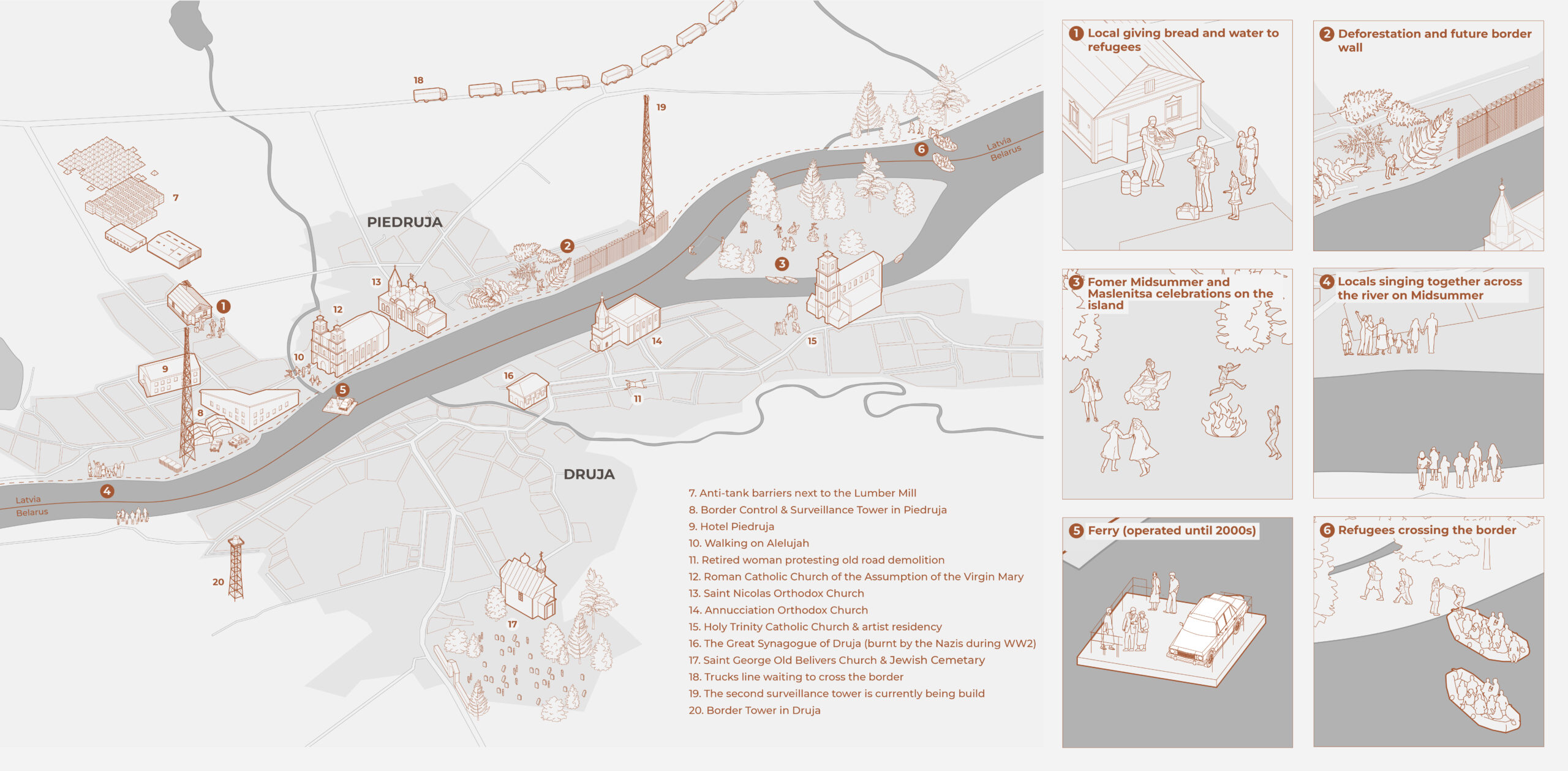
Map of Piedruja-Druja
Danute Līva and Darya Akhrameika
In 2021, the Belarusian dictator Lukashenko orchestrated a migrant influx into neighbouring EU countries. Belarusian authorities permitted 12 firms the right to issue Belarusian visas in regions affected by war, poverty and climate change, particularly in Iraq, Syria and Yemen, accompanied by false promises of easy entry into the EU. After being pushed through the border wall by the Belarusian border guards into Poland, Lithuania, and Latvia, refugees face the brutal reality of pushbacks. Unwelcome in these neighbouring countries, they remain stranded in the borderland. When encountered by border guards, they face physical and verbal abuse, including the use of electroshocks and sonic weapons. For border guards, smashing refugees’ phones has become routine practice.
The government of Latvia uses publicly available data on border crossings to artificially inflate the number of refugees crossing daily. In the government data, crossing attempts only count instances, not individuals. Detained refugees we spoke to in Latvia described many cases where, after being turned away, migrants walk further along the wall, find a less militarised spot, and try to enter again. Sometimes, they may be meeting a smuggler on the other side of the border. By obfuscating the fact that one person might be crossing several times per day, the total number of people crossing appears larger, and migrants are turned into numbers. The time they’ve spent in the borderland is obscured, much like their personhood. In 2024, Latvia registered 5388 pushbacks, and in 2025, there were 12,046.
In 2024, 26 individuals were admitted into Latvia on so-called “humanitarian grounds.” In these cases, those whose lives are in danger are taken to a hospital. Once they recover, border guards again employ pushbacks while the government boasts about its humanitarian goodwill.
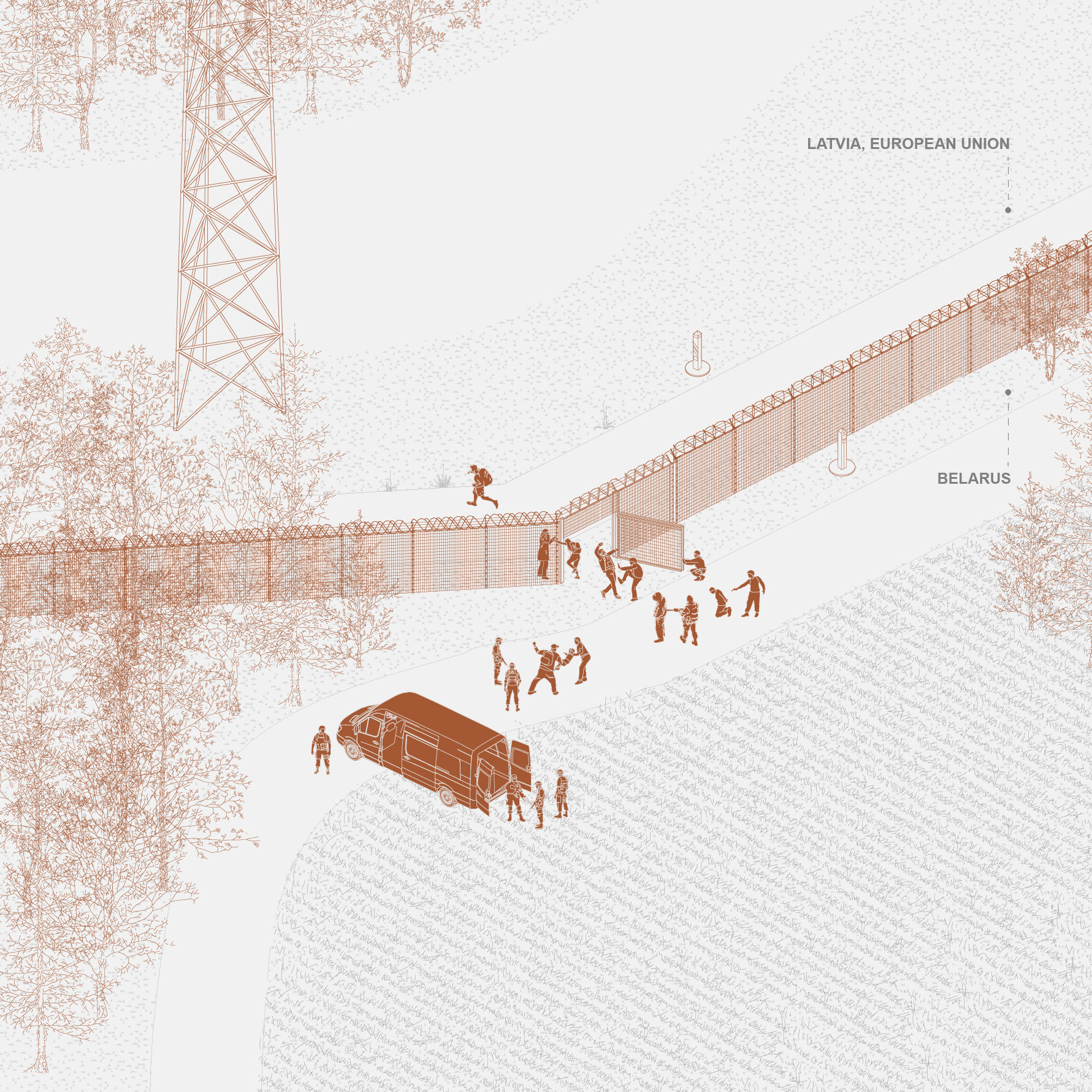
Border guards pushing back refugees
Danute Līva and Darya Akhrameika
Another tool of the government’s violent system is the 30m² tarp tent. Scattered along the border, refugees have described them as empty generic military tents, some with a heater inside. Most of the time, they have been described as overcrowded, with 30 to 90 people per tent. Instead of serving humanitarian purposes, as Latvian authorities suggest, they serve as unofficial detention facilities used as outposts to carry out daily pushbacks. The tarp tents are like the extended hand of the government, keeping migrants at arm’s length from the possibility of applying for international protection. People are taken to these tents by force and have their phones confiscated or damaged upon arrival. Some migrants undergo body searches, including strip searches. Refugees are deprived of their own agency, not knowing where exactly they are or if they will get anything to eat. For hygiene, they are given two bottles of water and soap.
These experiences are undocumented and invisible in the media, as they happen behind closed doors, in locations hidden from society. Latvian media manufactures consent for the pushbacks: refugees are dehumanised by being called illegal and portrayed as a danger to the public, without any mention that, most of the time, they have nowhere to return to. In March of 2026, the online magazine NRA published an article with the headline “A Record Number Of Illegal Migrants Caught on The Border of Latvia,” portraying migrants as a group to be caught and contained, rather than as human beings deserving of basic rights. The violence committed by border guards is left out of the story, covering up the fact that the government itself poses a threat to human lives.

Visualisation of tarp tents, based on refugees’ testimonies
Danute Līva and Darya Akhrameika
The lived experiences of these migrants are invisibilised, as are their deaths. It may never be known how many people died on the borderland, due to restricted access and other challenges with data collection. On paper, both Latvia and Belarus have guidelines on what to do with unidentified bodies and how relatives of the deceased could contact authorities to obtain a death certificate. However, this information is classified as restricted-access, making it inaccessible even to local NGOs. In Belarus, migrant families may face numerous obstacles to obtaining information about their deceased loved ones, and authorities do not actively facilitate the repatriation process.
In Latvia, bodies of the deceased are buried in the municipality where the person passed away. Refugees are usually buried in cemeteries that aren’t actively used and are adjacent to small, abandoned hamlets, or are only accessible via ploughed fields. The bodies are buried in unmarked parts of these cemeteries. Over time, the graves become a seamless part of the landscape, leaving no hint that a body lies buried there.
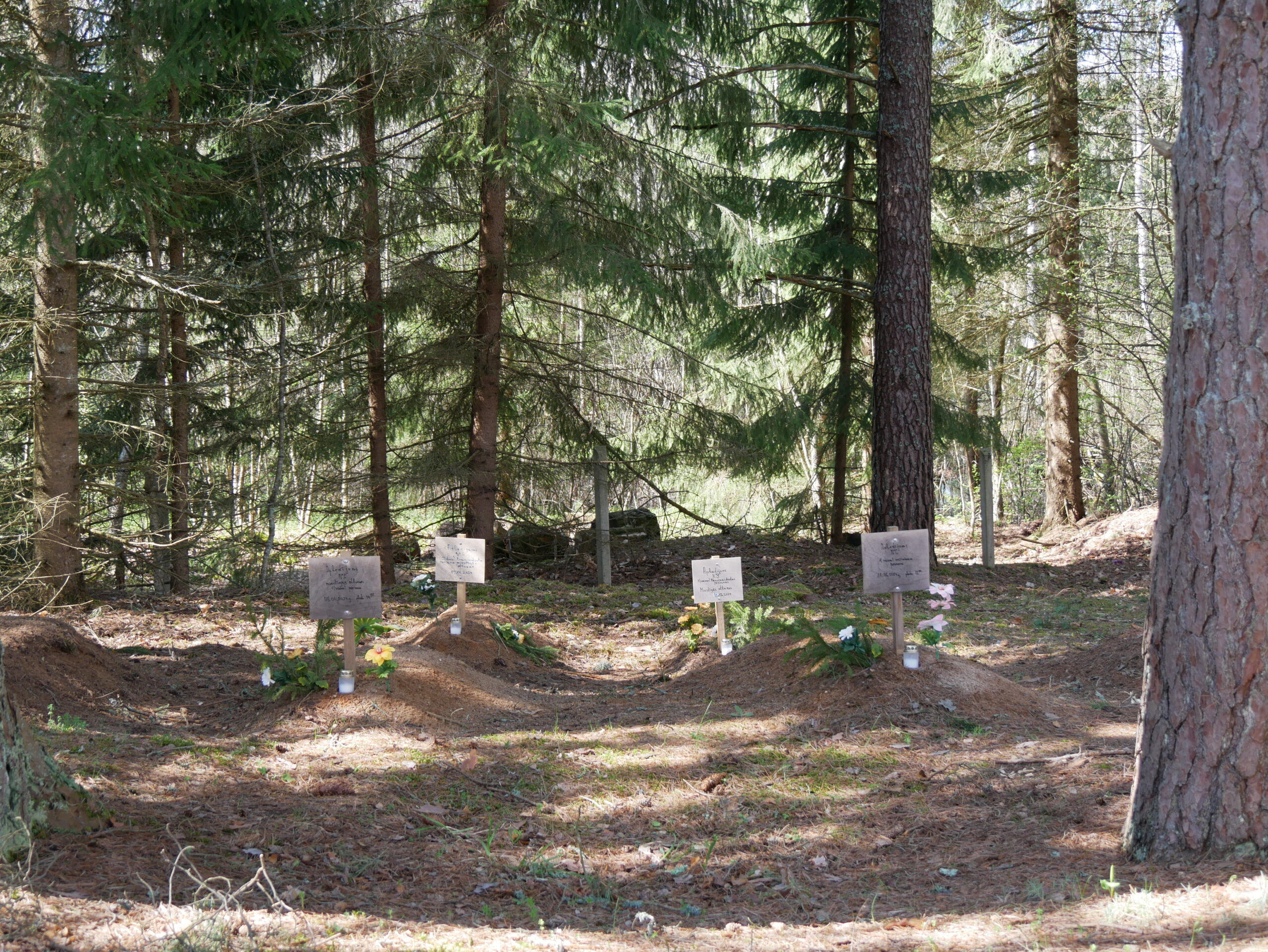
Unidentified refugees’ graves at Zaščirina Cemetery, 2025. Wooden planks, flowers, and candles are placed by the NGO I Want to Help Refugees.
Danute Līva and Darya Akhrameika
How will Piedruja-Druja look in five years? Will there be any traces left of elements unrelated to the military? Given Europe’s growing xenophobia and current geopolitical climate, this is unlikely. Many EU governments, including Latvia, have drastically increased their military and defence budgets, and human life is being erased from the towns and landscapes along border lines. This erasure first unfolds socially and culturally, through the division of communities. Physical injury follows, as vulnerable people are subject to violence. Even in death, these lives are invisibilized. Bodies are left unidentified and transported to hidden graveyards. What could reverse this growing militarisation and exclusion? At the root of the required scale of structural change is a simple idea: a respect for human life.