New fascisms do not form a coherent, singular project. Instead, a multiplicity of distinct yet interconnected opportunistic efforts to consolidate wealth and power at the expense of the planet. Historical forms of racial, religious and imperial domination are being reworked through contemporary alliances of state and corporate power, energy dependencies and extractive technologies amid accelerating climate breakdown. From Western Sahara to Kashmir, NATO to West Papua, authoritarian regimes are creating a future where planetary survival is put at risk in the name of growth and expansionist projects.
This open call asks: how do new fascisms produce the spatial conditions of their power, and foreclose other ways of inhabiting the planet? In this context, what possibilities for counter-worlds can we still imagine and enact through spatial practices of resistance?
Across the globe, authoritarian governments and far-right movements have increasing control and influence. Long-standing geopolitical alliances and global orders are reshaped by energy dependencies and renewed imperial ambitions. These shifts are produced through capitalism’s deepening crises: the defence of extractive economies and the consolidation of new forms of state and corporate power. In this remaking of the global order, former imperial powers continue to live off the privileges of past extraction, while exploiting the language of security, democracy and stability to forge alliances that deepen their hold on new frontiers of accumulation.
Against this backdrop, imperial logics and fascist power produce architectures of domination and extraction across different scales and geographies. They take shape through megaprojects, settlements, logistics corridors, energy infrastructures, luxury enclaves, reconstruction plans, property regimes and extractive landscapes. From Modi’s central vista redevelopment of New Delhi alongside the settler-colonial expansion in Kashmir, to the strategic use of waterways such as the Strait of Hormuz, architecture and infrastructure have long been entangled with territorial control, extraction, and nation-building. In the South Caucasus, post-war reconstruction in Artsakh following the mass displacement of its Armenian population and debates around the proposed Zangezur Corridor similarly show how roads, railways, borders and energy routes can become instruments of regional power and territorial control. Meanwhile, the billionaire class promoting generative AI machines do so in service of extractive power, through data centres and their demands for land, energy and water – the cost is our critical thinking, imagination and environment. These are but a few examples of how processes of fascisation, unfolding across geographies along different trajectories and with different temporalities, are consolidating power, reshaping energy infrastructure, and deepening our reliance on extractive technologies at the expense of a habitable planet.
New fascisms produce space through war, ethnic cleansing, forced displacement and the erasure of existing environments, memories and ways of life. Here, demolition becomes a tool of construction; architectures and infrastructures follow. How do territory, property, cartography and construction become architectural weapons within this context? Most urgently, what role do these spatial regimes play in making the planet increasingly uninhabitable?
Mark Fisher’s much-cited formulation in Capitalist Realism that “it is easier to imagine an end to the world than an end to capitalism” feels increasingly ominous after years of war and genocide, and amid the emerging realities of climate breakdown. What was once named a crisis of political imagination now also describes a spatial condition: the end of the world is not only being imagined, but currently being constructed. This series also asks what it would mean to reverse the question spatially. What might places look and feel like after capitalism, after fascism, after empire, or beyond extraction? Do we need to wait for these regimes to end or are there already spatial practices, struggles, or unrealised models that might help chart a route towards a habitable planet?
We invite essays, visual storytelling, podcasts, oral histories, interviews, reports, case studies and speculative fictions that focus on the architectures of imperial, authoritarian and fascist power, and/or the counter-worlds that urgently need to arise against them.
1. Critical analyses
Pieces that examine how new fascisms and processes of fascisation are producing oppressive and uninhabitable spatial worlds through megaprojects, energy infrastructure, increasing climate inequality, property, extraction and war. These contributions should be grounded in specific places, projects, territories, images, infrastructures or spatial processes that are unfolding.
2. Counter-imaginaries
Pieces that either critically propose, or examine the models that have been tested in the past, or are currently being tested, towards a spatial alternative beyond extraction. These could take the form of speculative essays, visual storytelling, examinations of activist struggles, or case studies of past futures that never came.
Deadline for pitches: 24th November 2026. Please follow the pitching guidelines on our “Contribute” page.
For special series articles, we are able to provide a fee of €150, all thanks to the generous donations of supporters who make sure Failed Architecture can stay independent.
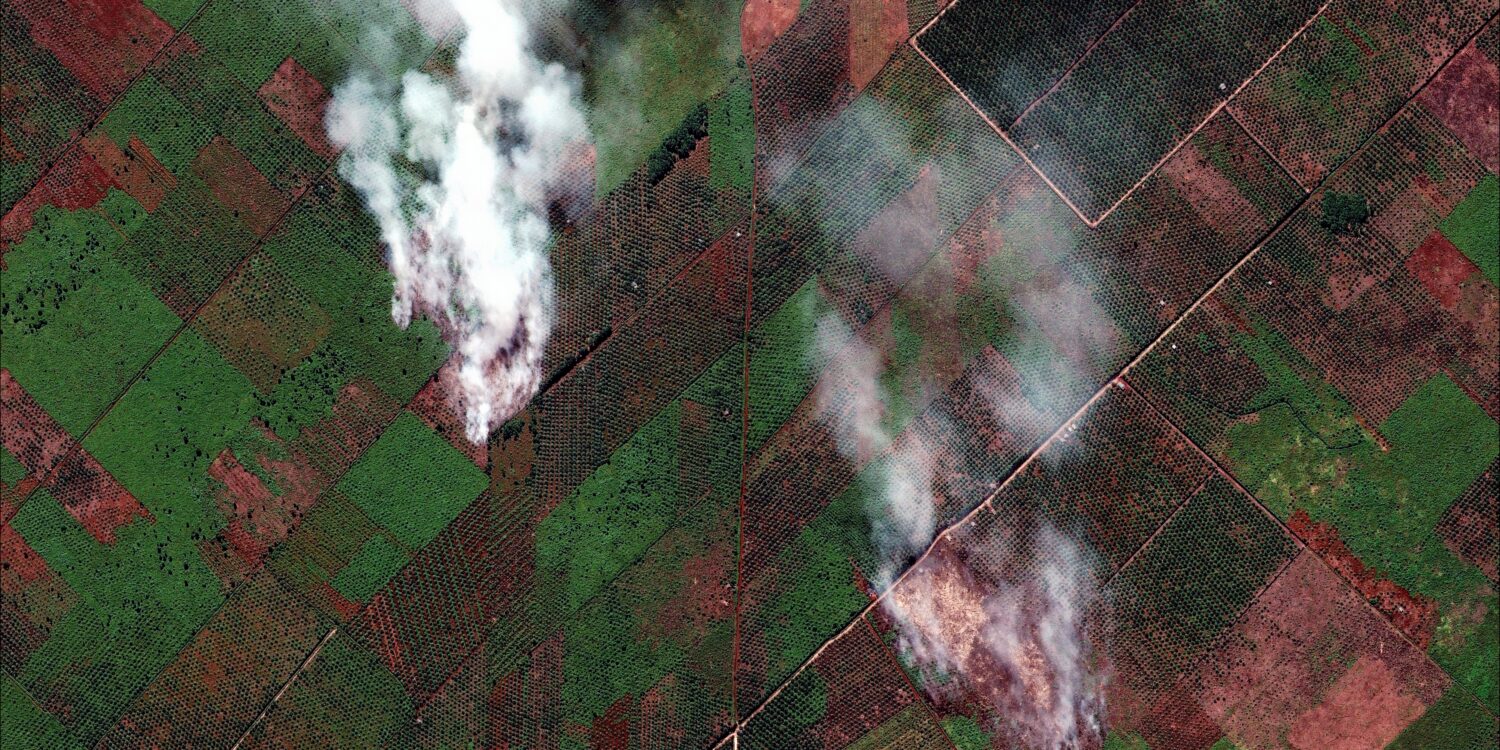
Image from the World Resources Institute showing a man-made wildfire in Sumatra Indonesia on June 26th, 2014.