This article is part of the FA special series Everywhere Walls, Borders, Prisons.
The Korean Demilitarised Zone (DMZ) was not born simply from war but from the entrenchment of global ideological rivalry. It is one of the most significant spatial remnants of the Cold War, and a place where 20th-century geopolitics continues to cast a long shadow. Over time, the DMZ has become a spatial and ecological paradox, a militarised landscape that has inadvertently become a sanctuary for natural life. Watchtowers, landmines, and propaganda architecture dotted across its 250-kilometre stretch illustrate an eerie, liminal state of permanent standstill, while white-naped cranes have returned to breed in wetlands and endangered bears scurry past surveillance equipment.
The DMZ was not conceived through Korean self-determination but by external powers during the 1945 Potsdam Conference, where the U.S, the U.K, and the Soviet Union met to agree on post war arrangements. With Japan’s surrender, U.S. military planners proposed to divide Korea along the 38th parallel north as a temporary measure to prevent full Soviet control of the peninsula. This decision placed Seoul under U.S. control and laid the groundwork for decades of political discord, eventually hardening into the militarized border we now know as the DMZ.
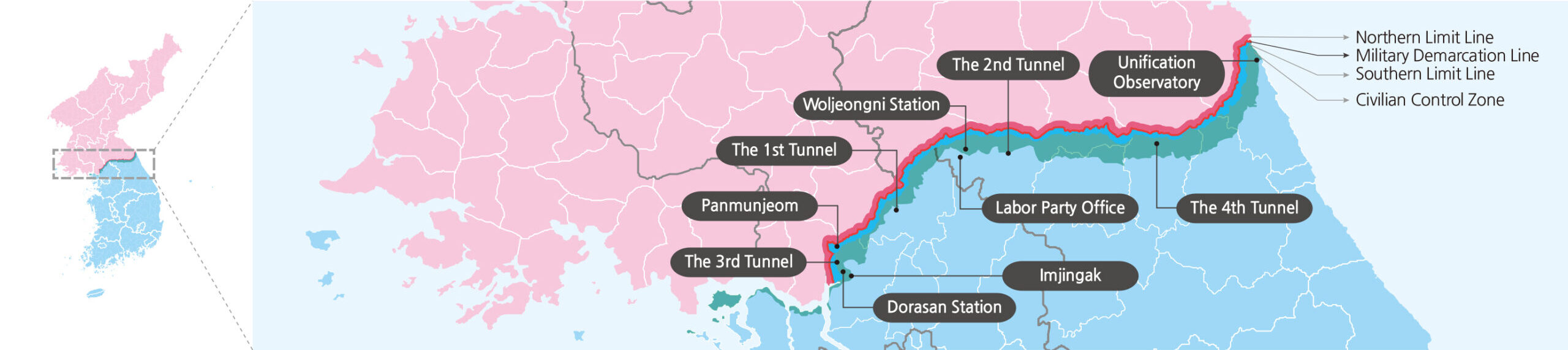
The Demilitarised Zone (DMZ).
Korea National Atlas
With the onset of the Cold War, what was intended as an interim measure solidified into two separate governments permanently being established in the North and the South. In the South, the Republic of Korea (ROK) was established under Rhee Syngman, a nationalist and a loyal anti-communist backed by the US, inaugurating a political system modeled on Western liberal democracy and market capitalism. Despite this, Rhee ruled in an increasingly authoritarian and forceful manner, especially during times of political unrest.
In the North, the Democratic People’s Republic of Korea (DPRK) was formed under Kim Il-sung with support from the Soviet Union, adopting policies based on Soviet communism: the idea that private property and modes of production should be collectively owned and managed by the state. However, while these policies were presented as a roadmap toward equality, they served to concentrate power in the hands of the ruling few.
Though both governments claimed to be the only legitimate government of Korea, their vastly different political systems backed by feuding foreign powers made reunification impossible. The U.S. framed its involvement with South Korea as a necessary task in containing the spread of communism in Asia, while the Soviet Union viewed North Korea as a strategic shield against Western imperialism. The result was not just two different governments, but two entirely different systems of living that split a people in half, creating irreconcilable political, economic, social, and cultural chasms. The temporary demarcation has essentially become a permanent structure, changing how people on either side live, are educated, and eventually see the world.
The DMZ is a product of its time, the paranoia that was rampant during the Cold War, and is an example of how a small, poor society was used as a political pawn and destination for a proxy war to reinforce the ideological agenda of world superpowers. This ideological divide culminated violently in the Korean War (1950–1953) and despite the 1953 armistice, no peace treaty was ever signed, leaving the two nations still technically at war with each other.
These ideological hostilities are still clearly and spatially visible today in the DMZ’s “propaganda villages” either side of the border. Hundreds of villages in the way of the border had to be cleared, forcing thousands to flee their homes. Among the few exceptions was Daeseong-dong (Freedom Village) in South Korea, a pre-war village that was allowed to remain under strict military control. On the other hand, Kijong-dong (Peace Village) was constructed from scratch by North Korea as a propaganda tool, designed not only to mirror the civilian presence of Daeseong-dong but to surpass it.
Kijong-dong (Peace Village) in the North consists of tall concrete buildings and even the use of electricity, which at the time reflected an unprecedented level of luxury and technology for Koreans, North or South, in the 1950s. However, upon a closer look, one can see that it is an empty town of fake buildings – windows are painted on, some openings lack glazing, lights are timer-activated, and not a single civilian can be spotted. The buildings appear to be shells and when the lights are turned on, they appear dimmer towards the bottom of the building, implying that there are no floors, nor interior walls. It is a 1:1 scale model of North Korea’s idea of prosperity and ideological triumph. It is a Potemkin village, a theatre set rather than an authentic, lived reality. While it does not convince anyone in the South anymore, Kijong-dong is still used by the North as part of a broader ideological standoff and is representative of the enduring cold war posturing between the two nations.
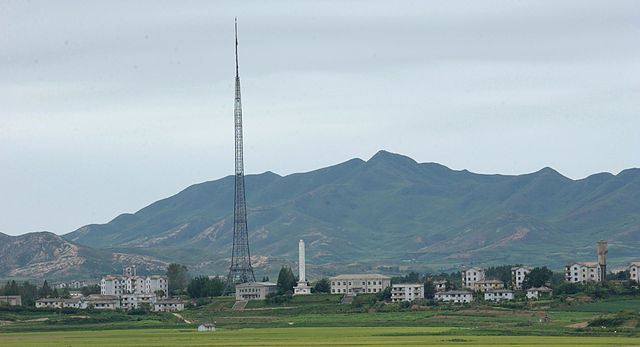
Kijong-Don seen from the Joint Security Area in the DMZ.
Jack Braden, Creative Commons
The South Korean Daeseong-dong (Freedom Village) is a seemingly humble, unassuming village where a civilian population actually lives under extreme military surveillance. The residents are exempt from otherwise compulsory military service, rent, and taxes in return for the symbolic role they play in maintaining a South Korean civilian presence so close to the border. Yet, living in this “Freedom Village” comes with a steep price – movement is tightly restricted, daily routines are informed by strict curfews and military checkpoints, and the remote, rural environment offers little appeal to younger populations drawn to job opportunities and fast-paced urban lifestyle. In truth, the village’s name is more symbolic than literal. Those who live within it are surrounded by checkpoints, rules, and armed guards, rendering freedom a projected idea rather than a lived reality.
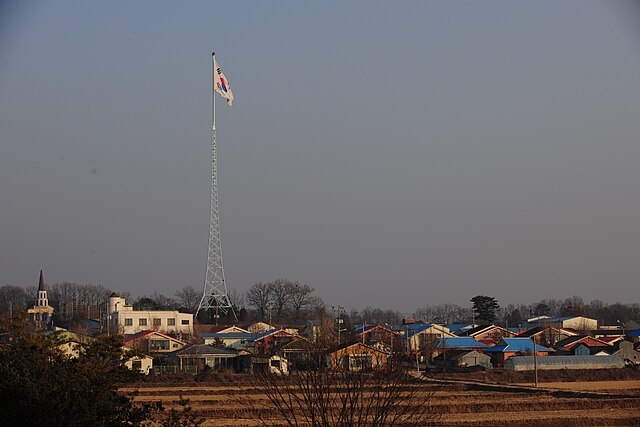
Daeseong-dong seen from the Joint Security Area in the DMZ.
Jong-u Park, Creative Commons
For decades, these villages have rattled with psychological warfare. Loudspeakers on both sides have broadcast clashing messages. South Korean K-pop, news, and defector testimonies set against North Korean nationalistic anthems and denouncements with the sole purpose of antagonising each other and instilling “the grass is greener on the other side” sentiments for those across the border. The DMZ is therefore not only a geographical boundary but also a political soundscape, where sound becomes a weapon, blasting nationalism at maximum volume. These broadcasts, while often dismissed as silly propaganda drills, underline how space in and near the DMZ is saturated with spectacle and antagonism under the symbolic guise of peace. The goal is not communication, but psychological operation. Neither side is listening, but both continue to project into the void. For both Koreas, the role of the villages is not about engaging with the other side’s illusions but more about asserting their ideologies through presence and visibility.
These villages, devoid of authentic daily life, operate as spatial theatres of ideology. This performative use of space supplements the broader logic of the DMZ, a militarised void that functions less as a place for human life and more as a canvas for projecting state identity. These villages are physical and acoustic monuments to a conflict suspended in time with no clear resolution in sight.
Meanwhile, within this backdrop of control and ideological projection, an unexpected counter-narrative has emerged. While the propaganda villages were carefully constructed to indicate human presence, it is the absence of humans that has allowed something else to flourish. What no one anticipated was that this 4 kilometre zone stretched between the two adversaries would grow into one of Korea’s most biodiverse regions. Today, this narrow border strip fosters more than 5,000 species of flora and fauna, including over 100 that are considered endangered. National monument species considered threatened have come back from a long period of wane. This recovery of biodiversity is even more significant considering that many of these species have declining habitats anywhere else on the peninsula due to urbanisation.
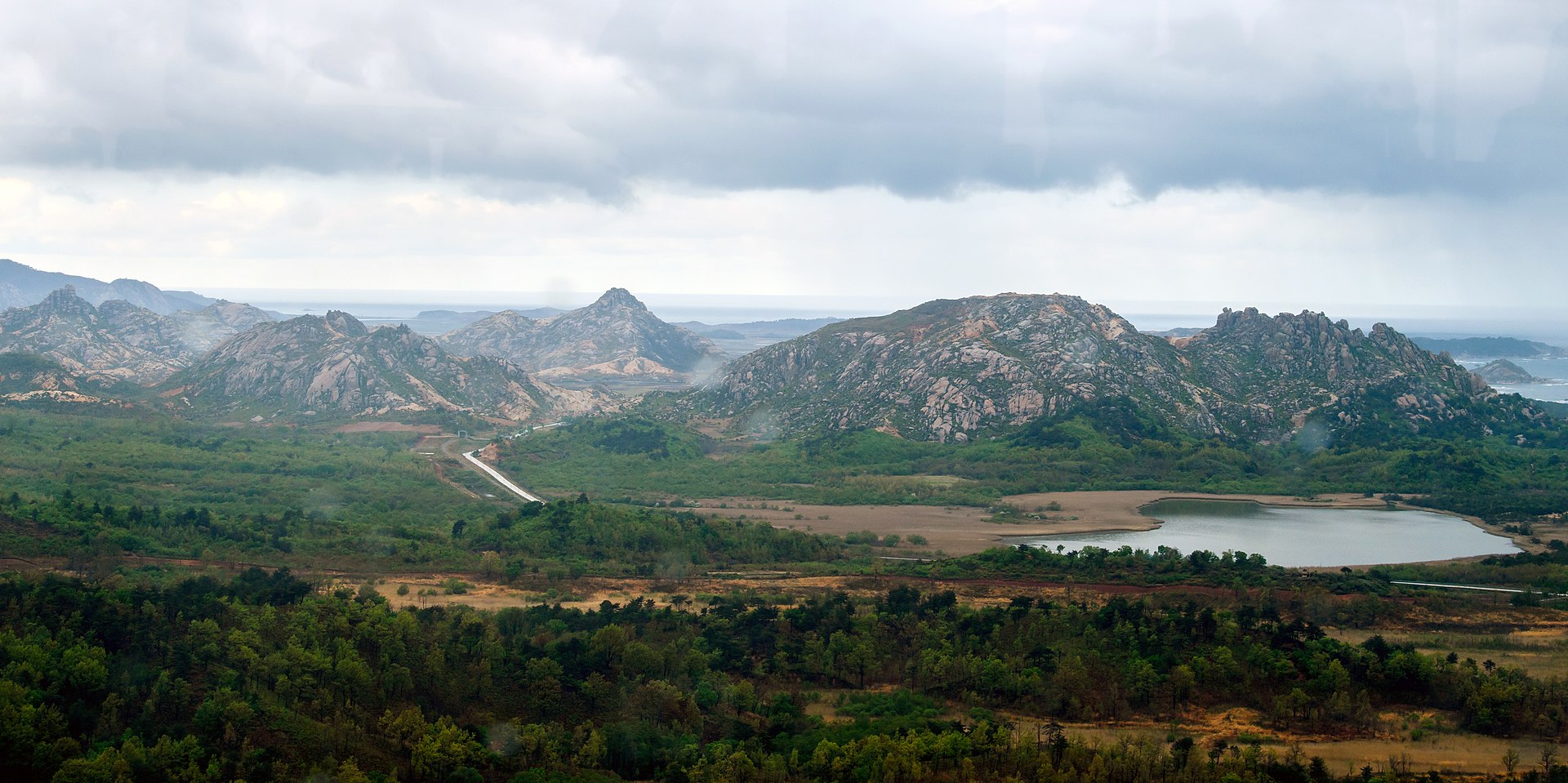
The eastern end of the DMZ.
Minseok Kang, Creative Commons
The DMZ’s evolution into a wildlife sanctuary is a strong example of revitalisation through neglect. Its diverse landscape of forests, mountains, brackish water, reed fields, clear streams, wetlands, and rivers has played a crucial role in nurturing and healing biodiversity. With civilians forbidden and soldiers restricted to assigned posts, the environment has for more than 70 years been left to its own devices, a rare opportunity to regenerate without interference. Unlike national parks or other areas allocated for conservation, there were no revitalisation initiatives; nature simply took advantage of human absence. What makes the DMZ so captivating is that despite being a heavily militarised zone, or perhaps precisely because of it, it has become one of the most ecologically vibrant areas in Korea. This unintentional transformation reveals the deep irony of modern geopolitics, that non-human life can flourish in human exclusion. The absence of humans has allowed its forests to grow again, rivers to run clear, and ecosystems to revive.
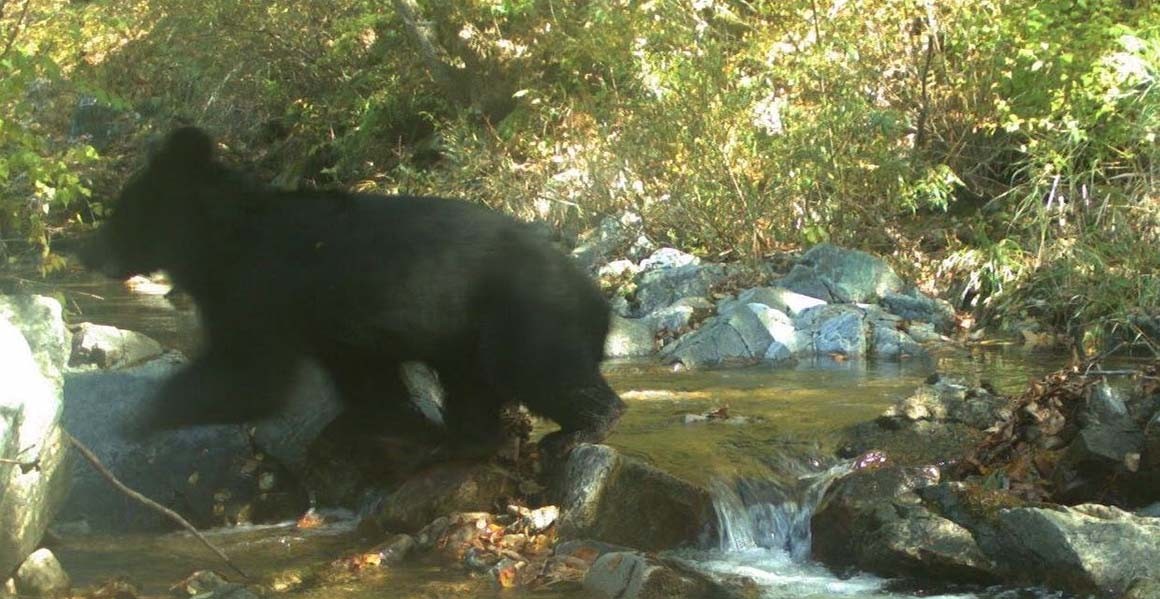
Asiatic black bear spotted on surveillance footage.
National Institute of Ecology / Google Arts & Culture
While some efforts at ecological research and protection exist mainly from South Korean agencies and international conservation groups, the zone’s ecological condition remains essentially ungoverned. Initiating research projects in the DMZ is a logistically complex and politically sensitive endeavour. Researchers have to obtain multiple institutional and governmental permits, such as from the South Korean Ministry of Environment, the Ministry of National Defense, and in many cases, the United Nations Command. The research excursions are conducted in short fragments lasting only a day or two, with South Korean military supervision at all times. Equipment is minimal and often restricted to non-invasive tools such as camera traps, bioacoustic monitors, and portable soil and water testing kits. Satellite and drone imagery also contribute to these surveys, although aerial access is also tightly controlled.
Despite these limitations, the findings have been remarkable. Researchers have reported a wide range of rare species that have come back and found refuge in the thriving landscape. Among them are endangered red-crowned cranes and the white-naped crane, both of which use the DMZ wetlands as a breeding ground and migratory stay. Surveillance footage has revealed the comeback of Asiatic black bears, Amur leopard cats, Eurasian otters, and water deer among many. Botanical surveys have shown thriving communities of rare wetland plants that have long been eradicated from nearby ecosystems.
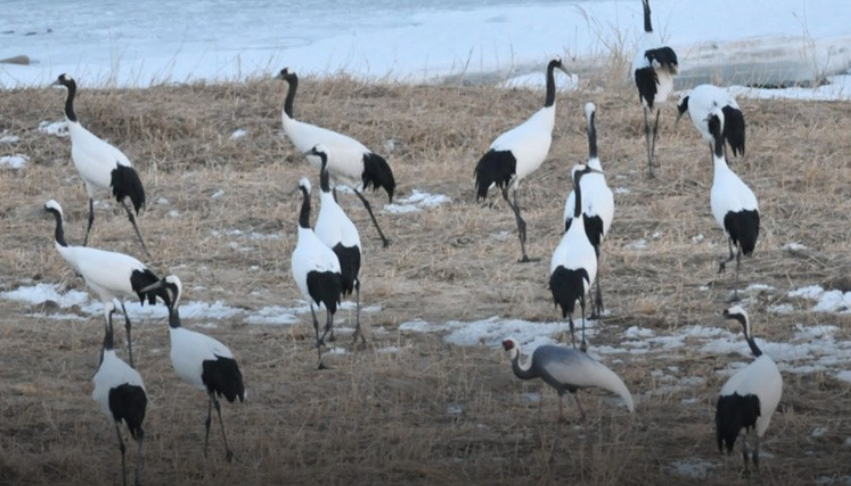
The DMZ is an important breeding ground for cranes. Of 15 crane species in the world, 7 are found in Korea.
National Institute of Ecology / Google Arts & Culture
However, these findings have had little impact on conservation policy. While the South Korean government has in theory committed to the long-term goal of conservation in the DMZ, in practice there is no formal management in place. The multi-jurisdictional nature of the DMZ makes it difficult to empower one single entity to enforce conservation initiatives. Furthermore, the border is designed precisely to prevent humans crossing, therefore complicating any enduring presence of conservation experts patrolling the area. Therefore, the existence of this “sanctuary” is paradoxical, with the territory still armed with an estimated 2 million landmines, tainting the romantic image of unadulterated wilderness. While many animals seem to have adapted to the terrain and appear to navigate around the mines, the threat remains real. How many lives have been lost silently in this paradox of defense?
The DMZ is often brought up as an example in spatial and landscape discourse for reimagining ecological conservation in the Anthropocene. It challenges the assumption that ecosystems require active management and care to flourish, and shows that the best thing humans can do for nature is to stay away. While often celebrated and romanticised as a precedent of unintentional ecological renewal, the DMZ’s transformation into a wildlife sanctuary demands a more critical lens, as it also reveals the dark irony that its natural abundance depends literally on perpetual threat of war. Its survival is in fragile equilibrium with a political stalemate. Furthermore, it is important to remember that the absence of human presence was not the result of radically enlightened ecocentric thinking but instead the result of heavily armed paralysis. It is a product of unresolved conflict and geopolitical hostility. To frame the DMZ as merely a conservation success story risks obscuring the absolute violence of war, and more than 70 years of human existential threat that made such “rehabilitation” possible in the first place. The same territory that nurtures this rich, blooming nature is sprinkled with landmines, surveillance towers, concrete tank traps, and barbed wire, not exactly a model for healthy conservation.
The case of DMZ is not one to provide cheerful, naive optimism for the future but a sobering reflection of decades worth of conflict leading up to the present day. It is a place where nature’s resilience is the direct result of extended deprivation of peace for the people. It forces us to confront an uncomfortable truth – that in the Anthropocene, nature may thrive in the shadows of human destruction, but at a moral and political cost that we cannot ignore, raising difficult questions about how we relate to the environment and to each other.